





How to build a strong team: a manager's step-by-step playbook
How to build a strong team, in order: the moves a manager makes to set direction, establish norms, build trust, run the rhythm, and catch trouble early.
Building a strong team is a sequence, not a pile of tips. Run the moves in the wrong order — a trust exercise before anyone knows who decides what, a culture conversation before there is a direction to be cultured around — and none of them hold. So this is how to build a strong team in the order the work has to happen: get the composition right, set a direction people can repeat back, make roles unambiguous, establish norms early, build trust by going first, install an operating rhythm, and earn commitment rather than assuming it.
Order matters because a strong team is not one thing. It is four things at once.
What you are actually building: the four dimensions of team cohesion
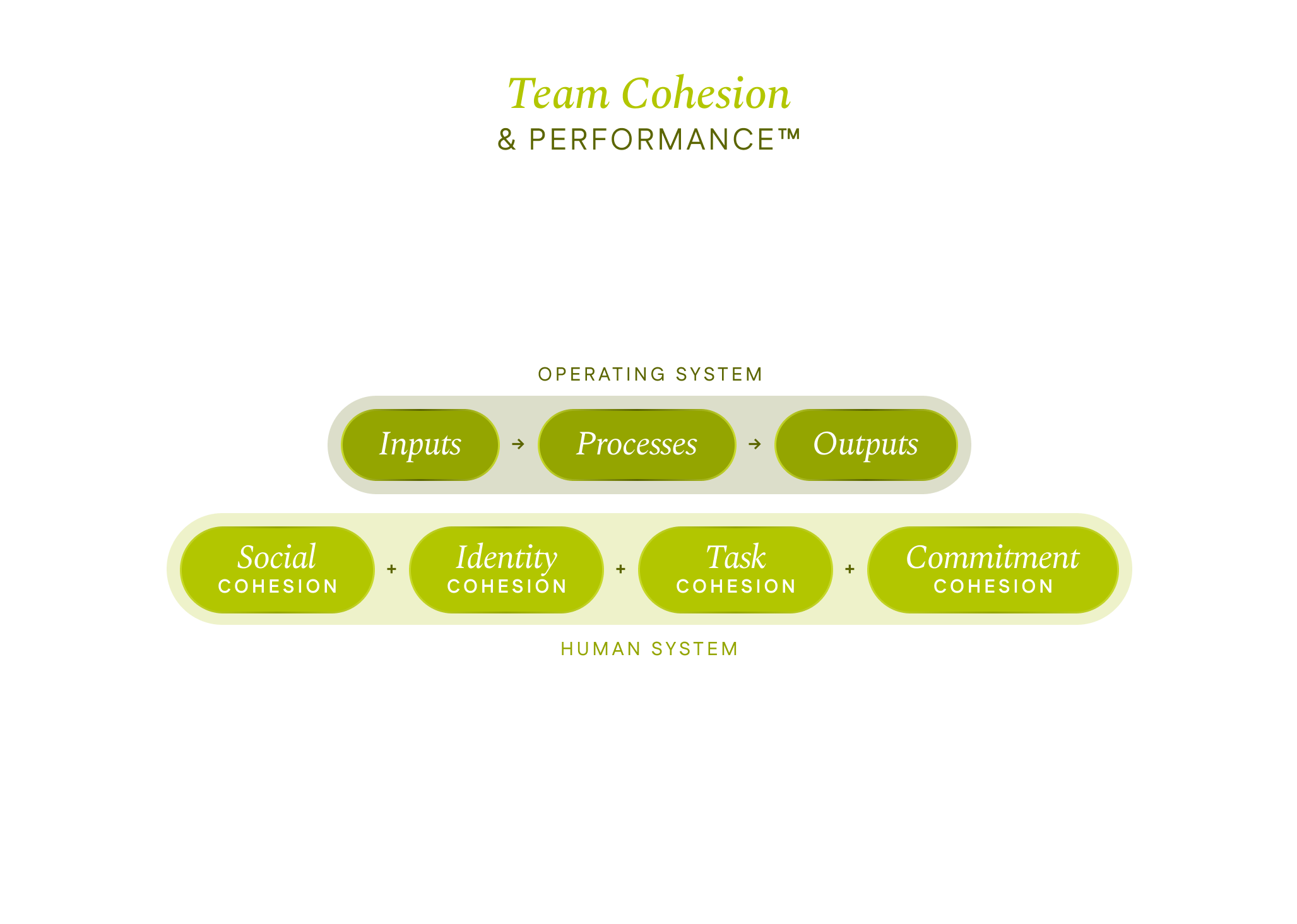
A team is strong when it is cohesive on four dimensions simultaneously. LeaderFactor’s Team Cohesion & Performance™ framework names them — Social, Task, Identity, and Commitment — the human system underneath any team’s results.
| Dimension | What it means | What its absence looks like |
|---|---|---|
| Social cohesion | People have real relationships and support each other | Help comes only when formally asked; nobody knows what anyone is carrying |
| Task cohesion | The team agrees on what it is doing and how the work fits together | Duplication, dropped handoffs, two people sure they own the same call |
| Identity cohesion | People feel they belong and identify with the team | The team gets described in the third person; wins pass unmarked |
| Commitment cohesion | People want to stay and will give extra effort | Work arrives exactly to spec and no further |
Most teams are strong on some and weak on others, which is why generic advice misfires. High task cohesion with low social cohesion executes well and quietly burns out. The reverse is a pleasant group producing overlapping work.
The build order: seven moves in sequence
- Get the composition right — who is on the team, and what the team is missing
- Set a direction people can repeat back — task cohesion
- Make roles and decision rights unambiguous — task cohesion
- Establish norms in week one — the team’s operating process
- Build trust by going first — social cohesion
- Install the operating rhythm — process and identity
- Build the “we” and earn the commitment — identity and commitment cohesion
Everything after step seven is maintenance: measure, practice, re-measure.
Step 1: Get the composition right before you try to fix the chemistry
No amount of facilitation compensates for a team missing a capability it needs weekly. Before you open a role, answer two questions: what does this team not currently have, and who is quietly absorbing that gap today?
Then hire for complementarity rather than resemblance — the instinct to hire people who work the way you do produces a team that fails the way you do. If you inherited the team instead of building it, watch real work for 60 to 90 days before moving anyone; most seats that look wrong in week two are role-clarity problems, which is step three.
Step 2: Set a direction people can repeat back to you
The test takes an afternoon: ask each person separately what the team is trying to achieve this quarter. If you get five different answers, you do not have a direction — you have a document.
Three practices close that gap fast:
- Articulate the team’s mission in one clear sentence and put it where the team actually looks, not in a deck nobody reopens.
- Have each person say the goal back in their own words. It feels redundant for ninety seconds, then it stops.
- Connect each person’s role to the goal out loud — not “your work matters,” but how their work moves what the team is measured on.
Then protect it. When priorities shift, restate the new priority and the reason, as a team, on the record. Silent re-prioritization is the fastest way to lose alignment you already had.
Step 3: Make roles and decision rights unambiguous
Most problems reported as “communication problems” are role problems in disguise. People are not failing to talk; they are talking without knowing who owns the outcome.
Build a one-page role clarity map: who decides, who implements, who advises, and who simply needs to be informed. Visible, revised whenever the work changes. It resolves the two most expensive team failures — the decision nobody makes because everyone assumes someone else owns it, and the decision two people make separately.
Then verify it individually. In one-on-ones, ask: “What do you think your main contribution to our team’s goals is?” The gap between their answer and yours is the work of this step. Repeat after every reorganization, because role clarity decays silently.
Step 4: Establish the norms in week one, not month three
Norms form whether or not you write them. The first time someone brings you bad news, disagrees with you in a meeting, or misses a date, your reaction becomes the standard. Writing norms deliberately claims that authorship before the defaults do.
Write four to six that are behavioral and enforceable, not aspirational. “Be respectful” is unenforceable. These are not:
- Decisions get written down with the owner’s name attached.
- Bad news travels immediately, and the messenger is thanked.
- Disagreement is expected before a decision, not after it.
- Whoever notices a gap owns raising it, whosever area it is in.
Then be the first person visibly held to them. Teams do pass through predictable phases as they form — Tuckman’s forming, storming, norming, performing — but phases describe what happens to a team, whereas norms are the part you control.
Step 5: Build trust by going first
Social cohesion is not friendship and not identical personalities. It is mutual care, trust, and enough openness that people will say a true thing about difficulty. You cannot request that. You can only go first and see who follows.
The behaviors are unglamorous and specific:
- In one-on-ones, ask “How are you doing?” before discussing any work — and let the answer take as long as it takes. Rush to the agenda and you have taught them the question was procedural.
- When someone mentions something hard, respond with “What would help right now?” rather than a solution or a sympathy noise.
- Model the vulnerability you want back. Share a challenge you are working through. Admit a mistake in a team setting, not just privately.
Watch for the blind spot: leaders routinely rate their team’s social cohesion higher than the team does, because they experience a version of the team curated for them. This is where cohesion and psychological safety in teams meet — people share real information only once they conclude it is safe.
Step 6: Install the operating rhythm
A rhythm turns those behaviors into a system. The cadence matters less than the fact that it is fixed and each meeting has one job.
| Cadence | What it is for | The move that makes it work |
|---|---|---|
| Weekly one-on-one | The person first, then the work | Open with the personal check-in and do not shortcut it |
| Weekly team meeting | Coordination, not status | Map who is doing what and where the work connects this week |
| Monthly retrospective | Improving how the team works | Reflect together, then change exactly one thing |
| Quarterly reset | Direction and roles | Restate goals, re-check the role map, reconfirm decision rights |
Two rules keep it honest. Anything that could have been written down should be — a meeting that reads aloud what everyone knows teaches the team that meetings are theater. And do not cancel the rhythm when things get busy; “too busy for the team meeting” is a signal the meeting stopped earning its slot.
Step 7: Build the “we” and earn the commitment
Identity cohesion is the sense that this is our team and being on it means something. It is built through repetition and story, not a values statement. Tell the team what a win was and what made it possible. When someone meets the standard, say “that’s the kind of team we are.” Use “we” and “our team” until it becomes the team’s language. Create one small tradition that marks accomplishments — a ritual outperforms an offsite because it repeats.
Commitment cohesion is last and the only dimension that cannot be mandated. People choose to stay and choose to give discretionary effort, which makes it the hardest to build and the most diagnostic. Three things move it:
- Name effort explicitly when you see it. “You really stepped up on that” beats a generic quarterly thank-you because it is specific and timely.
- Have real conversations about growth, not just the current role. Interest in someone’s future is evidence that their output is not the whole of your interest in them.
- Ask directly: “What would make you want to stay on this team?” Most managers first hear that answer in an exit interview.
How to spot the first signs of trouble
Teams rarely announce that cohesion is slipping. They leak it. Each dimension has a characteristic early tell, and reading which one is showing tells you where to intervene.
| The first thing you notice | Dimension weakening | What it usually means |
|---|---|---|
| People stop offering personal context; help routes around the team | Social | Trust is thin, or someone is struggling and has decided not to say so |
| Two people confidently claim the same decision; work gets redone | Task | Role clarity drifted, usually since the last priority change |
| The team gets described in the third person — “they decided” | Identity | The “we” never formed, or it fractured into subgroups |
| Work arrives exactly to spec; no volunteers for stretch work | Commitment | Discretionary effort has been withdrawn — often the last signal before a resignation |
One more: address interpersonal conflict promptly. Delay converts an ordinary disagreement into a faction, and factions cost far more to undo than the argument did to have.
How to build a strong team remotely or in a hybrid setup
Every step above still applies; what changes is that none of it happens incidentally. Co-located, you absorb signal for free — who looks overloaded, who is quietly at odds with whom. Remote, that signal does not arrive, and its absence reads as “everything is fine.”
So make the implicit explicit. Schedule the connection that used to be ambient. Write the role map down. Over-communicate every priority change, because there is no hallway in which people reconstruct it. And ask direct questions instead of waiting to notice — silence is not evidence of health, as the dynamics on virtual teams show sharply.
Measure, practice, re-measure
The step most managers skip is the one that makes the rest durable. Cohesion is measurable, and measuring it turns team building from instinct into a loop: measure where the team actually is, choose a small number of practices, run them, then measure again.
LeaderFactor’s COHESIONindex™ is built for that loop. It scores a team across all four dimensions using 20 items — five per dimension — on a seven-point agreement scale, in five to eight minutes. It runs as a leader self-assessment, or as a multirater assessment in which peers, direct reports, and a supervisor answer matched items about the same team.
Multirater mode is where the value sits, because it compares your view of the team with the team’s experience of it. Meaningful gaps sort into blind spots, where you rate the team higher than they do, and hidden strengths, where they rate it higher than you do. The first is more common, particularly on social and task cohesion.
Then narrow. Pick one or two dimensions rather than all four, choose two or three practices for each, run them long enough to become ordinary — 30-60-90 days is a reasonable arc — then re-measure. Visible improvement is what keeps team building alive past the first enthusiastic month. The full model lives on the Team Performance skill page.
Where to go next
Once the seven moves are running, the question shifts from building a functional team to raising its ceiling. Team cohesion covers the four dimensions in depth, so you can tell which one is actually your constraint, and high-performance teaming covers how collaboration is structured once cohesion is no longer the thing holding you back.
Frequently asked questions
- How do you build a strong team?
- Build a strong team in sequence: get the composition right, set a direction people can repeat back, make roles and decision rights unambiguous, establish norms early, build trust by going first, install a weekly operating rhythm, and earn commitment through recognition and growth. Order matters more than any individual tactic.
- What should a manager do first when building a new team?
- Start with clarity, not chemistry. Before any team-building activity, make sure every person can state what the team is trying to achieve and what they specifically own. Ask each person separately. Five different answers means there is no direction yet, only a document — and trust-building on top of confusion will not hold.
- How long does it take to build a strong team?
- Expect direction and role clarity within 30 days, visible norms and a working operating rhythm by 60, and early movement in trust and commitment around 90. Cohesion is built through repeated behavior, so a reasonable checkpoint is to re-measure the team roughly 90 days after making changes.
- How do you build a strong team when everyone works remotely?
- The same moves apply, but nothing happens incidentally. Remote managers must schedule the connection that used to be ambient, write down roles and decision rights, over-communicate every priority change, and create low-stakes informal channels. Assume you are missing signals about who is struggling and ask directly rather than waiting to notice.
- What are the first signs that a team is not coming together?
- Watch for four early signals: people stop sharing personal context, two people confidently claim the same decision, team members describe the team in third person, and work arrives exactly to spec and never further. Each maps to a different weakness — social, task, identity, and commitment cohesion respectively.