





Effective teamwork: the behaviors that make collaboration work
Effective teamwork is a set of behaviors, not a personality fit. Learn the coordination, communication, and role-clarity mechanics that make teams work well.
Effective teamwork is the set of observable behaviors a group uses to turn individual effort into a shared result — how people align on the goal, divide the work, hand it off, communicate as conditions change, disagree productively, and correct course together. It is not the same thing as chemistry, personality fit, or the raw talent on the roster. A group of strong individual performers can produce weak teamwork, and an ordinary group with disciplined coordination habits will routinely out-execute them. Teamwork is something a team does, visibly and repeatedly — which also means it can be learned, practiced, and measured.
What is effective teamwork?
Effective teamwork is coordinated behavior in service of a shared goal. It shows up in how work moves between people: whether the goal is understood the same way by everyone, whether ownership is unambiguous, whether handoffs land, whether a change in one person’s work reaches the people it affects, and whether disagreement produces a better decision instead of a quieter team.
The most useful distinction to hold onto is this: teamwork is not the same as individual task competence. You can staff a team entirely with people who are excellent at their jobs and still watch it produce duplicated work, missed dependencies, and decisions that keep getting reopened. Individual competence determines whether a task can be done well. Teamwork determines whether the right tasks get done, in the right order, without gaps or collisions between them.
Is teamwork a skill you can train?
Yes, and the evidence for it is reasonably strong. A 2017 meta-analysis published in PLOS ONE by McEwan and colleagues pooled 51 studies covering 72 separate interventions and 8,439 participants, and found that teamwork interventions produced positive, medium-sized effects on both teamwork behaviors (d = 0.55) and team performance (d = 0.58). Teams that are taught how to coordinate get measurably better at coordinating, and their output improves with it.
Just as useful is how that research organizes teamwork itself — into preparation (goal setting and planning), execution (communication, coordination, cooperation), reflection (monitoring performance and solving problems), and interpersonal dynamics (conflict management and social support). Every one of those is a behavior with a time and place, not a trait someone either has or lacks. That is the practical reason to stop recruiting for “team players” and start building team habits.
The six mechanics of effective teamwork
Most articles on this topic list qualities: trust, respect, communication, positive attitude. Those are outcomes, not instructions. Here is what the behavior actually looks like.
1. A goal every person can say back in their own words
Alignment is not a poster. The test is verbal: in a team meeting, ask each person to state what they think the team is trying to accomplish this quarter. If you get four different answers, you do not have a shared goal — you have a shared document. Run the check often enough that drift gets caught early, and rewrite the goal in language people can actually repeat.
2. Role clarity and explicit decision rights
The single highest-leverage artifact for a team is a one-page role clarity map: for each significant area of work, who decides, who implements, who advises, and who needs to be informed. Ambiguity about ownership is what produces both the duplicated work and the dropped ball, usually in the same week. Pair the map with a recurring one-on-one question — “what do you see as your main contribution to our goals?” — because role clarity that exists only in the leader’s head is not role clarity.
3. Coordinated handoffs and a shared definition of done
Work that crosses between people is where teams lose the most time. Two habits fix most of it. First, map the week’s dependencies out loud: who is doing what, and where does one person’s output become another’s input. Second, agree on what “done” means before the work starts — the standard the receiving person needs, not the standard the sending person assumed. A handoff that has to be redone is invisible on any dashboard and expensive on every timeline.
4. Closed-loop communication
Team researchers Eduardo Salas and colleagues identified closed-loop communication and shared mental models as the coordinating mechanisms that make a team’s other behaviors work at all. Closed-loop communication is simple in practice: the sender says it, the receiver confirms what they heard, and the sender verifies. It is standard in aviation and operating rooms for a reason. On an ordinary team it looks like ending a delegation with “so what are you taking away from this?” instead of “sound good?” — because “sound good” always sounds good.
5. Disagreement with a protocol
Teams do not fail because they argue; they fail because they argue without rules, or because they never argue and call it alignment. Give dissent a defined home: where it is raised, who holds the final call, and what the team owes the decision once it is made. Keep the challenge on the idea rather than the person, and state decisions explicitly so silence is never mistaken for agreement. The “meeting after the meeting” is a reliable sign that the disagreement had nowhere legitimate to go — a pattern worth reading alongside psychological safety in meetings.
6. A rhythm for realigning and reflecting
Priorities move. The behavior that separates coordinated teams from scrambling ones is that they realign as a unit and out loud — the new priority is restated, the reason is given, and the downstream effects on everyone’s work are named in the same conversation. Add a regular retrospective that ends in one changed behavior rather than a list of observations, and reflection stops being a ritual and starts being a control loop.
Where effective teamwork breaks down
Four failure signatures show up far more than the rest, and each maps to a mechanic above:
- Duplication and gaps in the same sprint. Two people solved the same problem while a third thing went untouched. That is a role clarity and coordination failure, not an effort failure.
- The silent handoff. Work was sent and assumed received. Nobody confirmed, and the delay surfaces a week later. Closed-loop communication is the fix.
- False consensus. The room nodded, the hallway disagreed, and the decision gets relitigated. The team lacks a protocol for dissent, so dissent went underground.
- Priority drift. Leadership changed direction and half the team is still executing the old plan. Realignment happened in someone’s inbox instead of in the team’s shared understanding.
Note what none of these are: a shortage of goodwill. Teams that like each other very much still ship duplicated work.
The LeaderFactor lens on how teams work together
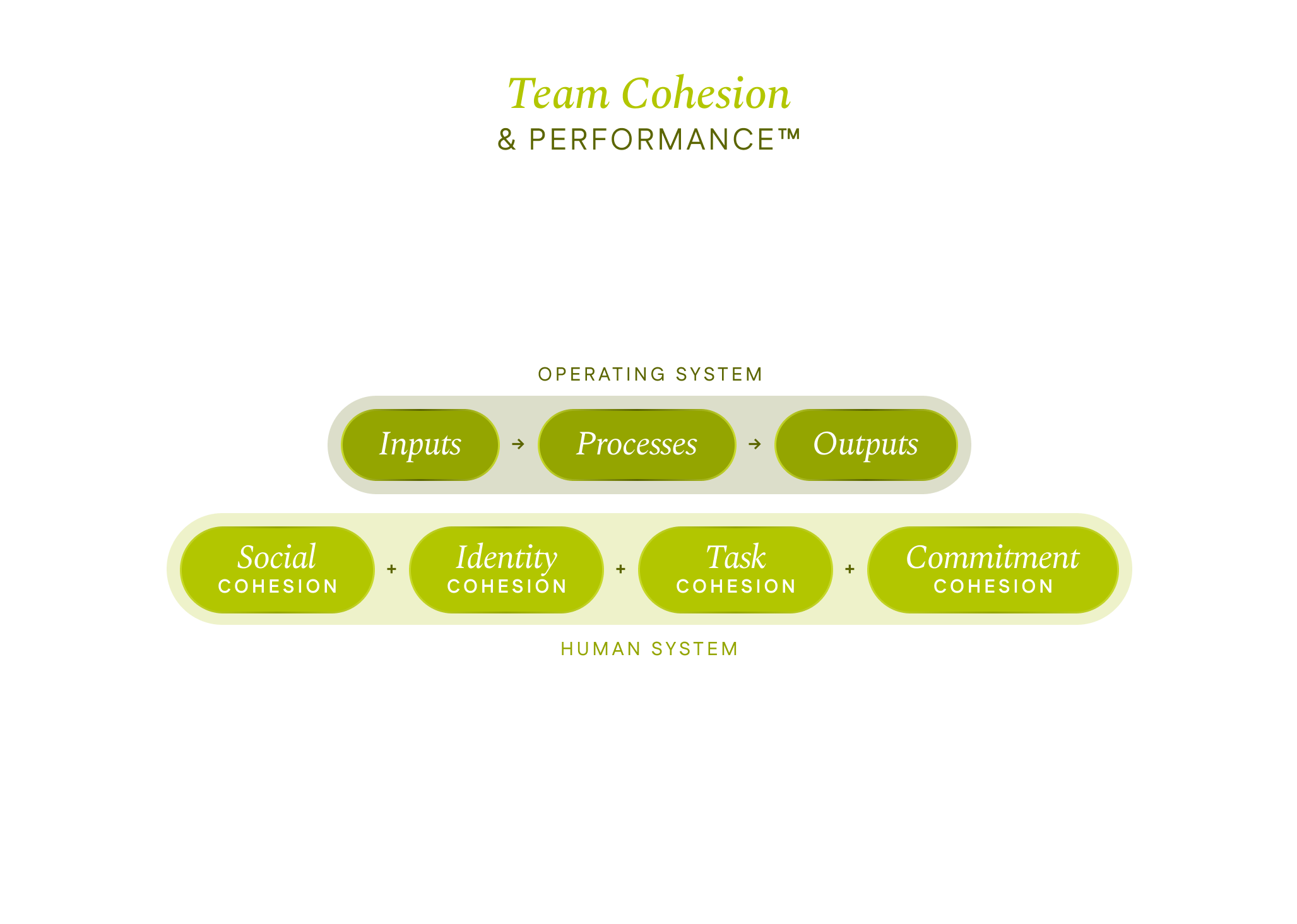
LeaderFactor’s Team Cohesion & Performance™ framework — the Seven Drivers of Team Performance — separates the human system holding a team together from the work system moving its output forward. On the human side sit four dimensions of cohesion: social, task, identity, and commitment. On the work side sit the team’s inputs, process, and outputs.
For effective teamwork specifically, the dimension that matters most is task cohesion: whether the team is aligned on what it is trying to accomplish and how the work fits together. Task cohesion covers shared understanding of the goal, the link between each role and that goal, clarity about roles and decision rights, coordination that avoids duplication and gaps, and the ability to realign quickly when priorities shift. It is the direct measurable counterpart to the six mechanics above. And, importantly, task cohesion is not the same as individual task competence — a team can be full of capable people and still be badly aligned.
The pattern worth bracing for: leaders consistently rate their team’s task alignment higher than their direct reports do. From where a leader sits, the goal looks obvious and the roles look settled, because the leader was in every conversation where they were decided. The people executing the work rarely had that vantage point. Assume the gap exists and go looking for it.
How do you know your teamwork is working?
Measure it on three levels rather than guessing from mood.
Behavioral evidence. Are people offering help before being asked? Do handoffs land the first time? Do decisions stay decided? Is the team catching its own gaps, or are you catching them?
Team-level data. Turnover, pulse results, project completion rates, and the frequency of rework are all downstream of coordination quality and easier to trend than a feeling.
Direct questions. Two of them do most of the work: “What does this team do best when working together?” and “If you could change one thing about how this team works together, what would it be?” Ask them in writing, ask everyone, and read the second answer carefully — it is usually a coordination complaint in disguise.
For a structured read, LeaderFactor’s COHESIONindex™ measures team cohesion across the four dimensions using a 20-item, 7-point agreement scale, in either a self-assessment or a multirater mode. Its value is the comparison rather than the score: running it as a multirater surfaces the gap between how a leader sees the team’s alignment and how the team experiences it, which is exactly the blind spot described above.
Where to go next
Start narrow. Choose the one mechanic your team is weakest on, run it for 30 days, and change nothing else — role clarity mapping and the say-it-back check are the two with the fastest payoff and the lowest cost. Then re-check.
If you want the broader context around how these behaviors connect to results, read high-performance teaming for the wider picture, and team cohesion for the four dimensions these mechanics are built on — task cohesion in particular is what most of this page is really about. Coordination habits only hold in a team where people are willing to say the inconvenient thing out loud.
Frequently asked questions
- What is effective teamwork?
- Effective teamwork is the set of observable behaviors a group uses to turn individual effort into a shared result — aligning on the goal, clarifying who decides and who does what, handing work off cleanly, communicating changes, disagreeing productively, and correcting course together. It is what a team does, not what a team is.
- What are the key elements of effective teamwork?
- Six mechanics carry most of the weight: a goal every member can restate in their own words, explicit role clarity and decision rights, coordinated handoffs with a shared definition of done, closed-loop communication that confirms receipt, a protocol for disagreement, and a standing rhythm for realigning and reflecting when conditions change.
- Is teamwork a skill you can learn, or is it just chemistry?
- Teamwork is trainable. A 2017 meta-analysis in PLOS ONE by McEwan and colleagues pooled 51 studies covering 8,439 participants and found teamwork interventions produced medium-sized improvements in both teamwork behaviors and team performance. Chemistry helps, but the coordination habits that drive results are practiced, not inherited.
- How do you handle disagreement without damaging the team?
- Give disagreement a protocol instead of leaving it to personality. Agree in advance on where dissent belongs, who holds the decision, and what happens after a call is made. Keep the argument on the work rather than the person, and name the decision explicitly so silence is never mistaken for agreement.
- How do you measure effective teamwork?
- Combine behavioral evidence with team-level data. Watch for duplicated work, dropped handoffs, and decisions that get relitigated. Track turnover, pulse results, and project completion. Then ask the team directly what it does best when working together and what one thing they would change about how the work flows.