





Teamwork training: coordination is the curriculum
Teamwork training designed for what teamwork actually is — coordinated behavior: the handoff, decision, and candor skills to train, and how to measure them.
Teamwork training inherits a definition problem from its own market: most of what’s sold under the name is rapport training — bonding, communication styles, the offsite with the ropes — built on the theory that teams that know each other work together well. The theory fails a daily test everyone has witnessed: teams full of genuine friends who still miss handoffs, duplicate work, and relitigate decisions. The fix is definitional, and LeaderFactor’s framing states it plainly: teamwork is coordinated behavior. Not effort, not goodwill — coordination. Train that, and teamwork training becomes a real curriculum with real measures. Here it is.
The coordination curriculum
Handoffs, mapped and repaired. Work leaks in the handoffs between people — the unowned decision, the assumption nobody checked, the four-day delay with no author. The training module that outperforms every trust fall: the team maps its three most recent leaks end-to-end, finds the pattern (it’s usually the same joint failing repeatedly), and redesigns that joint with an explicit contract — who hands what to whom, in what state, confirmed how. This is team-as-system work, done at ground level.
Decision rights, made explicit. Half of chronic team friction is undefined deciding: everyone assumed consultation was a vote. The trainable fix is the vocabulary and the habit — who holds each recurring call, what input each person’s actually giving, one-paragraph records so decisions stay decided. Teams install this in a single honest session and feel the difference within a week.
Candor behaviors, practiced. Coordination runs on early information: the flag raised while the problem is cheap, the “I’m behind” said Tuesday instead of discovered Friday. Those are safety-dependent behaviors — people surface problems where doing so is survivable — which makes the leader’s response patterns part of the teamwork curriculum, not a separate soft topic. Train the receiving as hard as the sending.
Rituals that hold it. The debrief after every significant miss (what leaked, which joint, what changes), the standing “what made your week stupid?” question, the visible decision log. Rituals are coordination’s maintenance schedule; teams that skip them re-teach the course annually.
Measure the team, not the mood
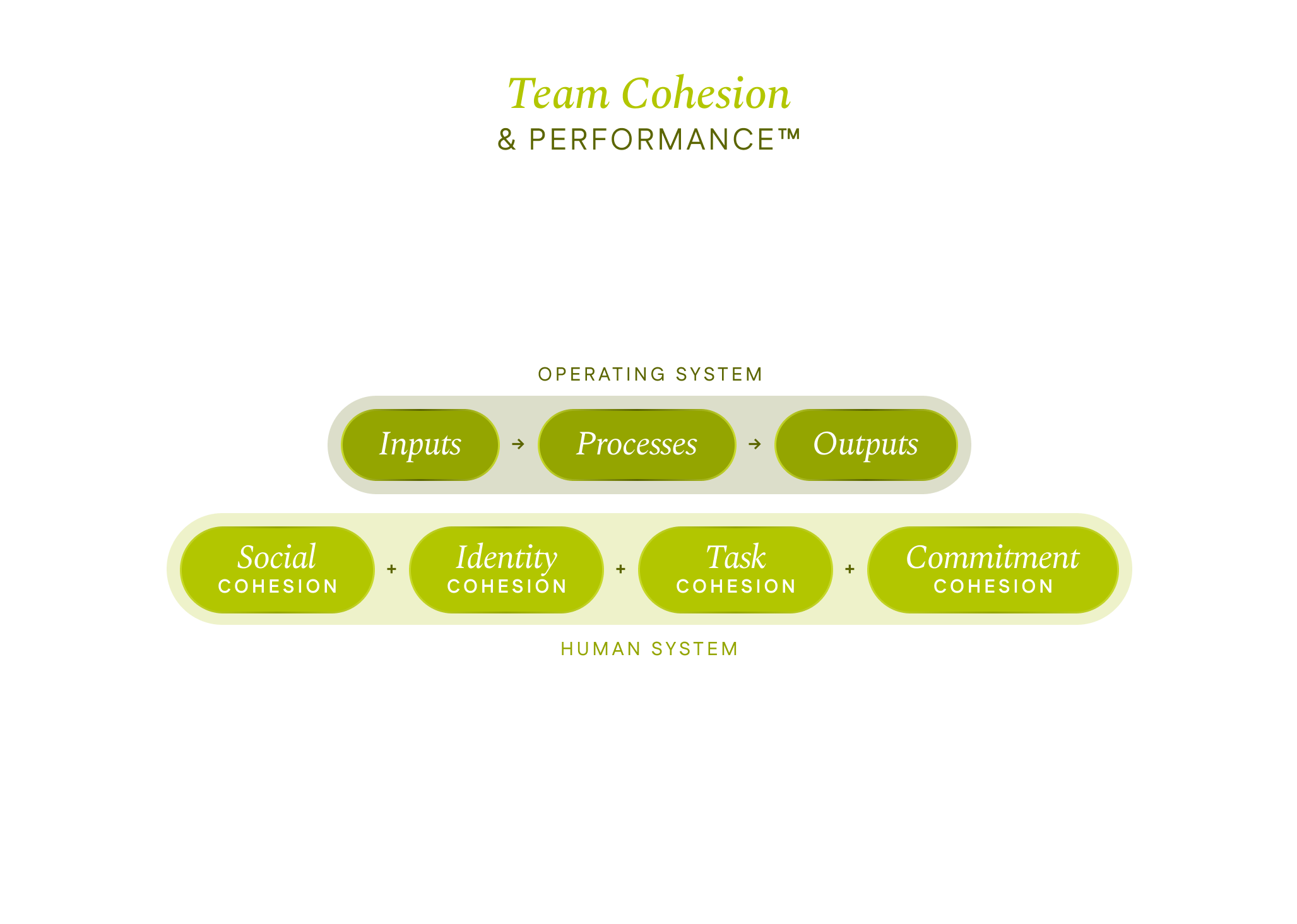
The category’s other inherited weakness is measurement-by-smile-sheet: the offsite scores 4.8, the handoffs stay broken. Teamwork is a team-level property, so it takes a team-level instrument — the whole team answering, so the score reflects the team’s experience rather than the loudest voice, baselined before training and re-measured after. That’s precisely what COHESIONindex™ is built for — the four cohesion dimensions plus the work system, whole-team — and the Team Performance skill wraps the full loop around it: baseline, targeted practice on the weakest driver, re-measure on a 30-60-90 rhythm. Pair the instrument with operational signals (handoff misses, decision cycle time, how early bad news arrives) and teamwork training becomes the rare L&D purchase that can prove itself.
The design implications follow the general program standards: intact teams, not mixed cohorts of strangers (coordination is a property of this team’s joints); the team’s real work as the practice material; and the leader’s own behaviors inside the curriculum, since a leader who punishes early flags will undo the candor module by Thursday. The rapport events, if beloved, can stay — as celebration, honestly labeled, after the coordination work.
It’s a Wednesday in October at an insurance-services firm in Des Moines, and an operations director is reviewing the strangest teamwork training her company has run: no offsite, no facilitator games — six working sessions in which her claims team mapped its own leaks, wrote handoff contracts for the two joints that caused most of them, published decision rights for the five recurring calls that used to circle, and baselined itself on a whole-team instrument. The re-measure lands in January: task cohesion up meaningfully, and the operational line she trusts more — rework from missed handoffs — down by a third. “The old training made us like each other,” one adjuster tells her in the debrief. “This one made Mondays make sense.” Both have value. Only one was teamwork.
Start where the leaks are: map your team’s last three, find the joint, and let that repair be the first module. The curriculum builds itself from there — and the instrument tells you whether it worked.
Frequently asked questions
- What is teamwork training?
- Training that builds a team's coordinated behavior: clean handoffs, clear decision rights, honest communication, and repair when work leaks between people. The serious versions train these as observable skills on the team's real work; the weak versions build rapport and hope coordination follows.
- What should teamwork training include?
- The coordination curriculum: mapping and fixing real handoffs, establishing who decides what, practicing candor behaviors like surfacing problems early, and installing team rituals — decision records, debriefs — that keep coordination running. Plus a team-level baseline so improvement is measurable.
- Does team building actually improve teamwork?
- Rapport events improve familiarity, which helps at the margins; they don't touch coordination, which is where teamwork actually fails. Teams that like each other still miss handoffs and relitigate decisions. Train the coordination behaviors directly and measure the team, not the mood.
- How do you measure teamwork training?
- At the team level, twice: baseline the team's cohesion and coordination with a whole-team instrument before training, re-measure after a practice window, and pair the scores with operational signals — handoff misses, decision cycle time, how early problems surface. Individual satisfaction scores measure the event, not the team.