





Team development: how to build a team that keeps getting better
Team development is the ongoing practice of strengthening how a team works together — what it means, what a plan looks like, who owns it, how to measure it.
Team development is the ongoing organizational practice of deliberately improving how a team works together. Not a one-time offsite — a repeating cycle of diagnosing the team, changing specific behaviors, and checking whether the change held. Most organizations do team building: an event, a facilitator, a good afternoon. Team development is the discipline that surrounds those events and makes them stick. It has an owner, a plan, a cadence, and a measurement.
That distinction changes what you are managing. An event is a line item. A practice is a system — and systems can be diagnosed, resourced, and held accountable.
What is team development?
Team development is the intentional, continuous work of strengthening a team’s ability to perform together. It operates on the human system of a team — the relationships, the shared understanding of the work, the sense of belonging, the willingness to give effort — rather than on individual skill alone.
That last point is where most programs go wrong. Sending five people to five training courses develops five individuals. It does not develop the team. A team can be staffed entirely with capable people and still coordinate badly, duplicate work, avoid conflict, and quietly lose members. Team development targets the connective tissue between people, which is a different object than individual capability and needs different tools.
Team development, team building, and the stages of team development
Three terms get used interchangeably. They are not the same thing.
- Team building is a discrete intervention — an offsite, a workshop, a retro, a game. It creates a moment.
- Team development is the ongoing practice that decides which interventions to run, why, and what should be different afterward.
- The stages of team development are a descriptive model — Bruce Tuckman’s forming, storming, norming, and performing sequence — explaining what a new team predictably goes through over time, covered in depth in the stages of team development.
The stages describe what happens to a team. Team development is what you do about it. Conflating the two is why so much of this work stalls: a leader learns the stages, recognizes the team is “storming,” and still has no idea what to change on Monday.
Why organizations invest in team development
Because the failure modes of an undeveloped team are expensive, and none of them appear on a skills matrix.
Coordination cost. When a team lacks a shared understanding of its goal, work gets duplicated, gaps go unfilled, and priorities are relitigated in every meeting. That cost is paid weekly and almost never named.
Late problem detection. Teams without strong relational bonds don’t surface bad news early. Problems arrive later, when they cost more to fix.
Turnover. People leave teams, not just companies. Someone who feels no belonging on their team is partly gone well before they resign.
Discretionary effort. The gap between what people must do and what they choose to do is where most team performance actually lives. It can’t be mandated — only earned.
Leadership readiness. Team development is where managers first learn to lead a system rather than administer tasks. Organizations that skip it promote people into scope they’ve never practiced.
What team development actually develops
This is where most guidance goes vague: “improve communication,” “build trust.” Those are outcomes, not targets. To develop something, you need a model that names the parts.
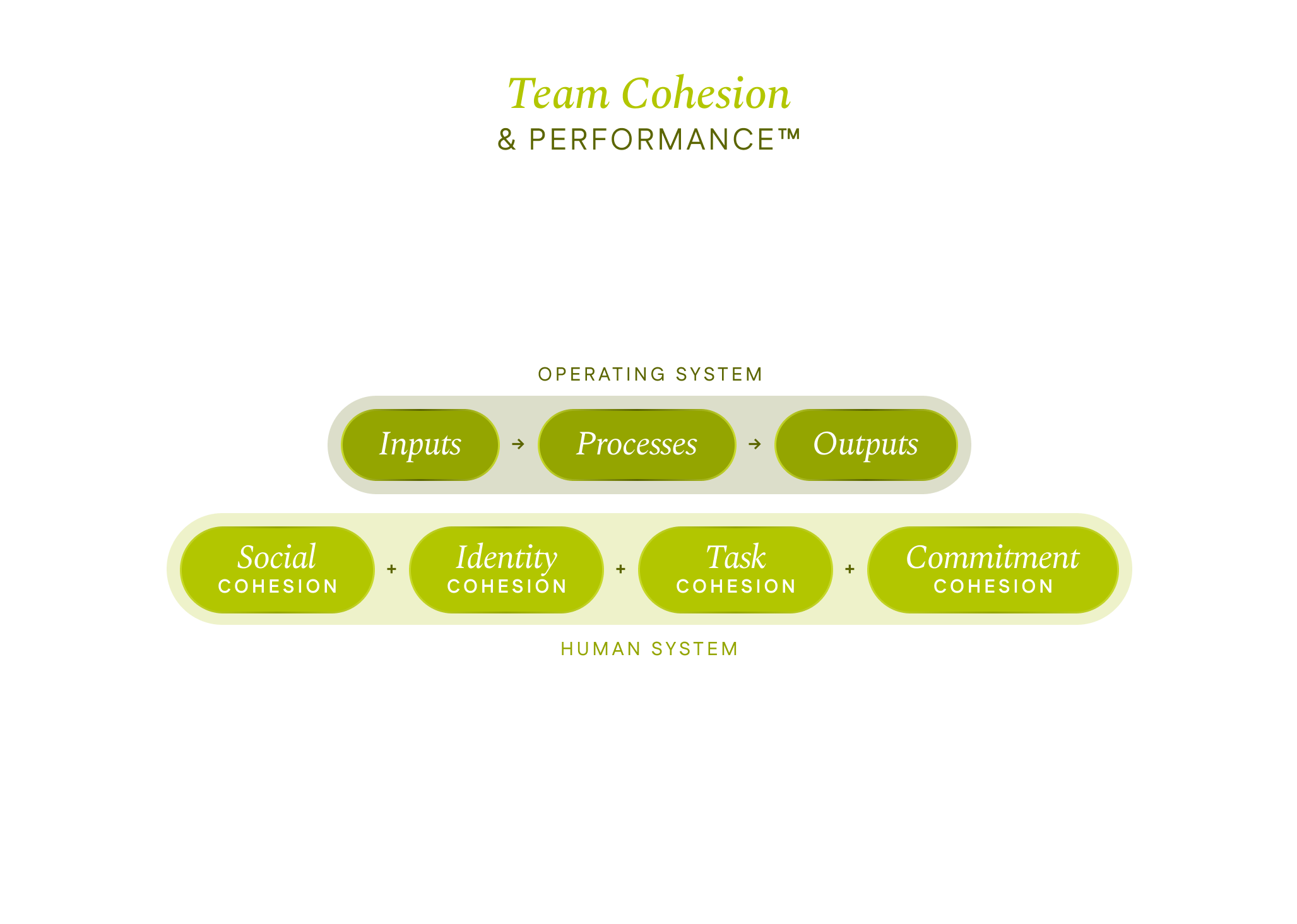
LeaderFactor’s Team Performance skill is built on the Seven Drivers of Team Performance, which separates a team’s human system from its work system. The human system is team cohesion, and it has four dimensions:
- Social cohesion — team members have strong interpersonal relationships and give each other encouragement and support. Not friendship: mutual care, interpersonal trust, and willingness to be open about difficulty.
- Task cohesion — the team is aligned on what it’s trying to accomplish and how the work fits together. Shared goals, clear roles and decision rights, coordinated workflows, and the ability to realign fast when priorities shift.
- Identity cohesion — people feel a real sense of belonging and identify with the team. Pride in membership, “we” language, shared purpose. Not uniformity.
- Commitment cohesion — people want to stay on the team and will give extra effort. Persistence through difficulty and voluntary contribution, which is not the same as compliance.
The work system is the team’s inputs (conditions, resources, constraints), process (how the work actually gets done), and outputs (results, and what the team learns from them).
The diagnostic value is in the pattern, not the average. A team can be socially warm and task-incoherent — everybody likes each other, nobody knows who decides. Another can execute crisply on high task cohesion while bleeding people because identity and commitment are thin. Those two teams need opposite interventions. A single “team health” score hides the difference; four dimensions make it visible, which is what turns high-performance teaming from an aspiration into a set of things you can actually work on.
What a team development plan looks like
A team development plan is a loop, not a document: measure → practice → re-measure. Everything else is detail.
1. Measure a baseline
Start with data, not intuition — leaders are unreliable narrators of their own teams. LeaderFactor’s COHESIONindex™ is a diagnostic team assessment built for exactly this: 20 items, five per dimension, answered on a seven-point agreement scale. Each dimension score is the mean of its five items, and the overall score is the mean of the four dimension scores — so no single dimension can dominate the composite. Scores map to five interpretation bands, running from Critical at the low end through Low, Moderate, and Strong to Very Strong.
It runs in two modes. In self-assessment mode, the team leader answers alone. In multi-rater mode, the leader’s supervisor, peers, direct reports, and other stakeholders answer matched items about the same team, with a minimum of three raters before a multi-rater report is produced.
2. Read the gap, not just the score
Multi-rater mode exists for one reason: the difference between how a leader sees the team and how everyone else experiences it. That gap is the most useful data in the exercise.
- Blind spot — the leader scores a dimension meaningfully higher than others do. Usually the leader is under-seeing friction. Task cohesion is a frequent offender: the goal is obvious from where the leader sits and ambiguous from everywhere else.
- Hidden strength — others score higher than the leader does. The team is prouder, more committed, or more connected than the leader realizes, and that strength is going unused.
- Alignment — leader and team see the dimension the same way, which makes it far easier to work on together.
A one-point gap is the practical threshold worth talking about. It’s a heuristic for focusing a coaching conversation, not a statistical test.
3. Pick one or two dimensions, not four
The most common way a team development plan fails is by targeting everything. Choose from the data: a dimension that’s a genuine blind spot, or one that’s foundational to the others. Social cohesion tends to be foundational; task cohesion tends to move fastest.
4. Convert the dimension into behaviors
This is the step that separates development from good intentions. “Improve social cohesion” isn’t actionable. These are:
- Social — in one-on-ones, ask “how are you doing?” before any work item; when someone names something hard, respond with “what would help right now?”; share a challenge you’re facing before asking anyone else to.
- Task — write the team’s mission in one sentence and post it where the team sees it; have each person say back what they think the team’s goal is; when priorities shift, restate the new priority and why; build a one-page map of who decides, who implements, who advises, who’s informed.
- Identity — tell stories about team wins and what made them possible; name it when the team behaves the way you want (“that’s the kind of team we are”); build one ritual that marks accomplishment.
- Commitment — name discretionary effort out loud when it happens; hold explicit career-growth conversations with each person; when work is hard, say so directly and say why it matters.
LeaderFactor’s behavioral guide organizes 30+ practices like these by dimension. The design principle is that each one is small, specific, and repeatable — a leader can start one tomorrow without a budget or a calendar invite.
5. Re-measure
Set the re-measurement date when you set the plan — typically around 90 days. Without it, team development quietly degrades into activity nobody checks. Re-measuring does three things: it tells you whether the behaviors moved the dimension, it reopens the gap analysis, and it signals to the team that this is a standing system rather than a phase.
Who owns team development?
Two owners, two different jobs.
The team leader owns the outcome. Cohesion is built in behaviors only the leader controls: how a meeting opens, whether roles get clarified, whether effort gets noticed. No program compensates for a leader who does none of that.
HR and L&D own the system. They supply the instrument, the cadence, the coaching capacity, and the accountability. Their job is to make team development the default operating rhythm — assessment at team formation and annually, plan review inside the leader’s own one-on-one, re-measurement already on the calendar — rather than something motivated leaders do voluntarily and everyone else skips.
Where this usually breaks: L&D owns the program, nobody owns the outcome, and the whole thing dies when the internal champion changes roles.
How to measure whether team development worked
Use three layers, because any one of them alone will mislead you.
- The instrument. The baseline-to-re-measure change on the dimension you targeted. This is the only layer that measures the thing you actually tried to change.
- Behavioral signals. Do people bring problems earlier? Does anyone volunteer for the hard work? Does disagreement happen in the meeting instead of after it? These move before survey scores do.
- Team metrics. Turnover, internal transfer requests, cycle time, pulse-survey trends. These move last and are the most contaminated by outside factors — which is exactly why they make poor leading indicators and useful confirming ones.
Collect the qualitative side too. Asking a team “what does this team do best when working together?” and “if you could change one thing about how this team works together, what would it be?” frequently produces the specific, actionable answer no score can give you.
What derails team development
- Treating the event as the program. The offsite is an input, not an outcome.
- Improving everything at once. Four dimensions targeted, zero progress made.
- Developing individuals and calling it team development. Different object, different tools.
- Skipping the baseline. Without one you can’t distinguish improvement from mood.
- Defensiveness about low scores. A low score is diagnostic data, not a verdict on the leader — and treating it as a verdict guarantees nobody answers honestly next time.
- No re-measurement date. The most common failure, and the most fatal.
Where to go next
- The stages of team development — the forming-to-performing model and what teams predictably go through.
- Team cohesion — the four dimensions development actually targets, and how to tell which one is weak.
- How to build a strong team — the manager-level playbook, in the order the moves matter.
- Team Performance — the four dimensions, the COHESIONindex™, and the behavioral guide in one place.
Frequently asked questions
- What is team development?
- Team development is the ongoing organizational practice of deliberately strengthening how a team works together, rather than leaving it to chance. It targets team cohesion — the social, task, identity, and commitment bonds that hold a team together — through a repeating loop of measuring the team, practicing specific behaviors, and measuring again.
- What is the difference between team development and team building?
- Team building usually means a discrete event — an offsite, a workshop, a game — designed to improve relationships. Team development is the ongoing practice that surrounds those events: diagnosing what the team actually needs, running specific behavioral practices over weeks and months, and re-measuring to confirm something changed.
- What should a team development plan include?
- A useful team development plan starts with a baseline measurement, names one or two priority areas rather than all of them, specifies concrete behaviors the leader and team will practice, sets a review cadence over roughly 30, 60, and 90 days, and ends with a re-measurement against the original baseline.
- How do you measure team development?
- Measure the condition, not just the output. LeaderFactor's COHESIONindex™ scores a team on 20 items — five each for social, task, identity, and commitment cohesion — on a seven-point agreement scale, in self or multi-rater mode. Pair that baseline with behavioral signals and team metrics, then re-measure after about 90 days.
- Who is responsible for team development?
- The team leader owns it, because cohesion is built in everyday behaviors only the leader controls — how meetings open, how roles are clarified, how effort is recognized. HR and L&D own the system around it: the assessment, the cadence, the coaching, and the accountability that keeps development from quietly stopping.