





Leadership communication training that changes sentences
Leadership communication training designed honestly: the behaviors worth training, the practice that transfers, and how to vet programs past the platitudes.
Leadership communication training is a category that mostly trains the wrong unit. The standard curriculum works at the level of traits and topics — “executive presence,” “storytelling,” “communicating with impact” — while actual leadership communication happens at the level of sentences said or unsaid in specific rooms: the direction that did or didn’t survive retelling, the feedback that did or didn’t name a behavior, the response to bad news that did or didn’t keep it coming. Training that changes leaders changes their sentences. Here’s what that version covers, and how to buy or build it.
The five behavior families worth training
Clarity: direction that survives retelling. The test of leadership communication isn’t the speech; it’s the third-hand version — what a frontline employee says the strategy is. Trainable behaviors: one-sentence framing of any initiative (what, why, what we’re not doing), reasoning stated with conclusions, and the discipline of checking the echo (“tell me how you’d explain this to your team”).
Feedback: the structured sentence. The highest-ROI communication behavior in the catalog, because it’s a learnable sentence shape — behavior, impact, guidance — that works for praise and correction alike. The B.I.G. structure is the curriculum; the practice venue is every week.
Listening: questions that do work. Not appreciative nodding — the working version: questions that transfer ownership (“what have you considered?”), that open before they narrow, that make the coaching move instead of collecting problems. Leaders’ listening behaviors are their most-watched communication, and the most trainable.
Candor reception: the response that prices truth. The family every curriculum skips and none should: how a leader receives hard information determines whether they keep getting it. Thanking the messenger before evaluating the message, responding to challenge with curiosity, owning mistakes plainly — these are communication behaviors, they’re rehearsable, and they’re the ones that build the safety that makes all other communication honest. A leader can be a superb transmitter and preside over silence; this family is why.
Calibration: audience, channel, moment. The judgment layer — technical depth for the engineers, decision-shape for the executives, written versus spoken, now versus after the room cools. Trainable mostly through critique of real artifacts: last week’s actual announcement, rewritten together.
Notice what the five families have in common: each resolves to behaviors a colleague could witness this week, which means each can be practiced in real venues and measured against a baseline — the standard that separates development from exposure.
Why this connects to emotional intelligence
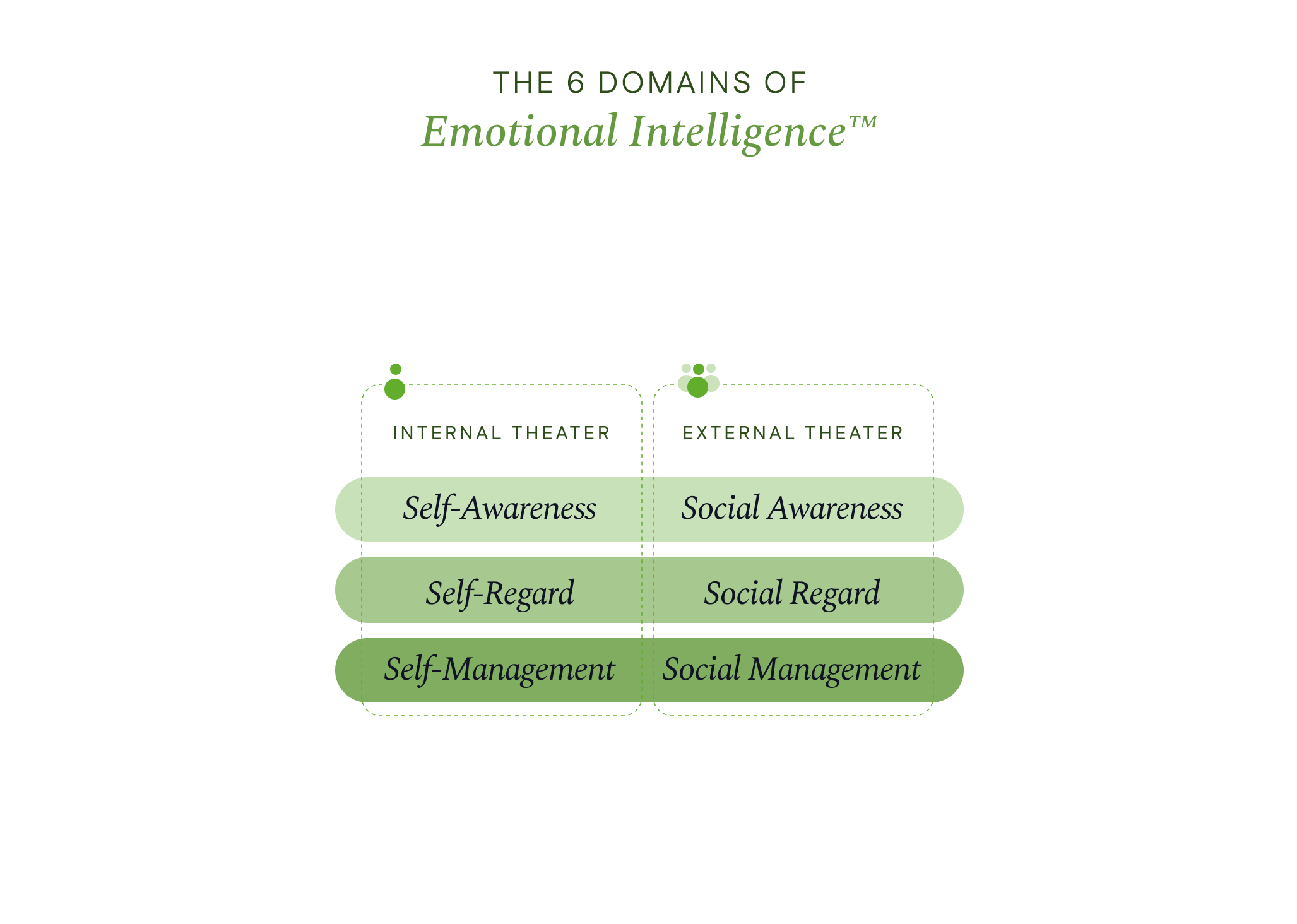
The families above are, underneath, applied emotional intelligence: reading the room is perception, calibration is regulation-in-action, feedback and candor reception are relationship management with the difficulty left in. That’s worth knowing when you design or buy, because communication training that ignores the EQ substrate produces technique without judgment — leaders who deploy the feedback formula with perfect structure and no read of the person receiving it. The strong programs train the sentence and the sensing; the conceptual companion to this page covers that definitional territory in full.
Buying or building it
The standard vetting applies — named behaviors, real-work practice, instrument, evidence — with two category-specific filters. First, beware the presentation-skills bait-and-switch: public-speaking training is a legitimate niche, but if the program’s practice venue is a stage and your leaders’ actual venue is Tuesday’s operations review, the transfer is near zero. Second, insist that candor-reception is on the syllabus; its absence marks a program built for how leaders send, which is half the job and the easier half.
It’s a Thursday in May at a payments company in Atlanta, and the VP of engineering is finishing the least glamorous communication training of her career: no stagecraft, no storytelling arc — six weeks, two behaviors (the one-sentence frame; thank-before-evaluate), practiced in her own staff meeting with a peer observing. The measure lands quietly a month later, in her skip-levels: three separate engineers describe the strategy accurately, and one mentions — unprompted — that “bad news doesn’t cost anything anymore, so you hear it Tuesday instead of month-end.” Her old training binder promised presence. The sentences delivered it.
Start where she did: pick the family your team would say you’re weakest in — ask them; the asking is itself the first rep — and train one behavior from it, in your real rooms, for ninety days. The general method carries the rest.
Frequently asked questions
- What is leadership communication training?
- Structured development of how leaders communicate: setting direction people can repeat, giving feedback that lands, running conversations that surface truth, and adjusting to audience and moment. The serious versions train observable sentence-level behaviors with practice and measurement, not presentation polish alone.
- What should leadership communication training cover?
- Five trainable families: clarity (direction that survives retelling), feedback (behavior-impact structure), listening (questions that transfer ownership), candor reception (responses that keep truth coming), and calibration (audience, channel, moment). Programs covering topics instead of behaviors produce awareness without change.
- How do you improve leadership communication skills?
- Behavior by behavior, in real venues: pick one communication behavior, practice it in the meetings and 1:1s you already run, recruit feedback on how it lands, and verify after a defined window. Communication improves like any leadership skill — through witnessed reps, not through knowing about communication.
- How do you evaluate a communication training program?
- Ask what behaviors it names, where practice happens, and what gets measured against what baseline. A program that can't list its target behaviors is selling content; one whose practice is classroom-only is selling rehearsal for a room you'll never be in again.