







Emotional intelligence training for leaders.
Your technical skill is the payload. Emotional intelligence is the delivery system. This program trains the six domains that decide whether a leader's expertise lands under pressure, and measures the change with the EQindex® before and after.
 EQindex® results in the LeaderFactor platform
The learning platform at leaderfactor.app, sample data.
- Format
- Cohort-based with self-paced modules. Live-virtual, on-demand, or in person.
- Length
- Four modules, then 60 to 90 days of deliberate practice on two skills.
- Instrument
- EQindex® baseline and re-measure, with an optional multi-rater view.
- Built for
- Leaders who derail under pressure, and the managers who inherit the weather.
Emotional intelligence training for leaders teaches a person to recognize, regulate, and work with emotions, in themselves and in the people they lead, and then to do it under pressure, when it counts. LeaderFactor defines emotional intelligence simply: the ability to interact effectively with other humans. The training question is sharper than the definition. When the pressure is on, does this leader’s expertise land, or does the room go quiet around them?
This page covers what a program should teach, why most of them stop at awareness, which delivery format fits which rollout, and the two questions to put to any provider before you sign.
Why most emotional intelligence training stops at awareness
The typical program runs a self-assessment, teaches a model, and hands each leader a report. People leave with a label. The brilliant, hard-to-work-with VP learns that she scores low on empathy, agrees, and goes back to the same Monday meeting with the same reflexes. Nothing in the design asked her to do anything differently, and nothing measured whether she did.
The misconception underneath this is that emotional intelligence is a trait, something you have more or less of and can at best learn to manage. It isn’t. It is a function of three things: what you believe and feel, what you know, and what you do. All three are learnable, and the order matters. Behavior always happens last. It reflects what happens upstream, in what a leader believes about their own worth and other people’s. Training that goes straight to behavior scripts (“make more eye contact”) without touching the beliefs underneath produces leaders who perform the skill and leak the intent.
So the program has to do two jobs. It has to change what a leader believes and notices, and then it has to give them reps.
What the training should cover: six domains in two theaters
LeaderFactor’s program is built on The 6 Domains of Emotional Intelligence™, a framework with complete symmetry between the work you do on yourself and the work you do with others.
The internal theater is what you run on yourself. Self-Awareness is the ability to recognize your thoughts, emotions, and behaviors. Self-Regard is the belief in your own inherent worth and potential. Self-Management is the ability to regulate what you think, feel, and do. The external theater mirrors it exactly, pointed outward: Social Awareness reads what is happening in others, Social Regard holds their worth and potential as real, and Social Management influences honestly, through trust rather than tricks and power tools.
Thirty learnable skills sit underneath the six domains, including the empathy skills most programs treat as untrainable. The one most leaders need first is the least glamorous. Across global norms, impulse control is the lowest-scoring skill for the human family, and it is the hardest of the self-management five to learn. Self-management begins in the pause, and a five-second pause is often all it takes.
One move per domain
A curriculum that teaches thirty skills at once produces a leader who practices none of them. The program gives each domain one imperative, and each leader chooses the one or two that their EQindex® results point at.
Look into a clean mirror, by triangulating your self-view against at least three outside sources of truth. Engage in positive self-talk, and talk to yourself like you mean it. Give yourself a yellow card before you act. Become a dual processor, registering the full experience in a room rather than only the words. Bridge, then bond: bridge where there is no natural affinity, bond where there is. And avoid tricks and power tools, because the tools of persuasion are built on social regard, and the influence spectrum runs from deception on one end to coercion on the other, with honest persuasion in the middle.
Consider a plant controller in a manufacturing business who scores high on every internal domain and low on Social Awareness. Her numbers are flawless and her month-end meetings are silent. Her EQindex® report says the gap is not confidence or regulation; it is that she hears the words and misses the room. Her one move for ninety days is to become a dual processor, and the practice is written into the meeting she already runs every Tuesday. That is what a target behavior looks like. It is small, it is hers, and it is scheduled.
Which format fits your rollout
Format follows the outcome you need, not the calendar.
- A leader cohort is the default for most organizations. Twenty to sixty leaders move through the modules together, debrief their EQindex® results as peers, and hold each other to their chosen behaviors. Leaders speak more candidly about where they leak under pressure among peers than in front of their own reports.
- Live-virtual, on-demand, or in person are delivery choices, not different programs. The framework, the instrument, and the practice window are the same in each. Choose by geography and calendar.
- Self-paced modules on their own are pre-work or wide-audience awareness. They define the domains well and change behavior poorly, because there is no practice partner and nobody is watching the retest.
Organizations that want the language shared from the executive team to first-line managers usually run leader cohorts first, then certify internal facilitators to carry the program to the next layer at their own cadence.
How you’ll know it worked
Measure the leader before and after. The program opens with an EQindex® baseline across all six domains and the thirty skills beneath them, so each leader sees where their internal and external theaters are strong and where they leak. After the practice window, they take it again. The movement in their own scores is the evidence, not a personality label.
The multi-rater option is where the measurement gets honest. Emotional intelligence is experienced by other people. A self-rating tells you how a leader sees themselves; the multi-rater view tells you how their leadership is lived by the people around them, and the report is only enhanced once at least three raters respond, which protects their anonymity. The gap between the two views is the number worth acting on, and closing it is the point of the training.
Ask any provider the two questions this implies. What will my leaders do differently in week three? And how will we know?
Where to start
Start with the leaders whose weather other people have to live in. Every organization can name them, and so can every engagement survey. Put them in the first cohort, let the EQindex® pick their two skills, and protect the ninety days of practice from the next reorg. Then take the retest, read it against the baseline, and decide the second cohort on evidence instead of on the strength of the first session’s reviews.
What the program covers
Four modules, six domains, one target behavior each.
The curriculum follows the framework. Every leader leaves each domain with a single behavior to practice, chosen from their own EQindex® results, not a list of thirty things to be better at.
-
Introduction and your baseline
What emotional intelligence is and isn't, why it is learnable, and a guided read of your own EQindex® profile across the six domains and thirty skills.
-
The internal theater
Self-Awareness, Self-Regard, and Self-Management. The moves: look into a clean mirror, engage in positive self-talk, and give yourself a yellow card before you act.
-
The external theater
Social Awareness, Social Regard, and Social Management. The moves: become a dual processor for content and emotion, bridge then bond, and influence without tricks or power tools.
-
Report and action plan
Each leader picks no more than two of the thirty skills to work on, writes the practice into real meetings and one-on-ones, and sets the retest date.
-
The practice window
Sixty to ninety days of practice in the flow of work. New muscle memory takes about that long, and the retest only means something after it.
-
Certify your own facilitators
Internal L&D teams can be certified to run the program at their own cadence, keeping the framework and the EQindex® intact.
Assess, learn, apply, prove. One platform.
The program runs on leaderfactor.app: the baseline, the cohort and self-paced modules, the application tools, and the re-measure, with org-level reporting for the people who bought it.
EQindex® baseline 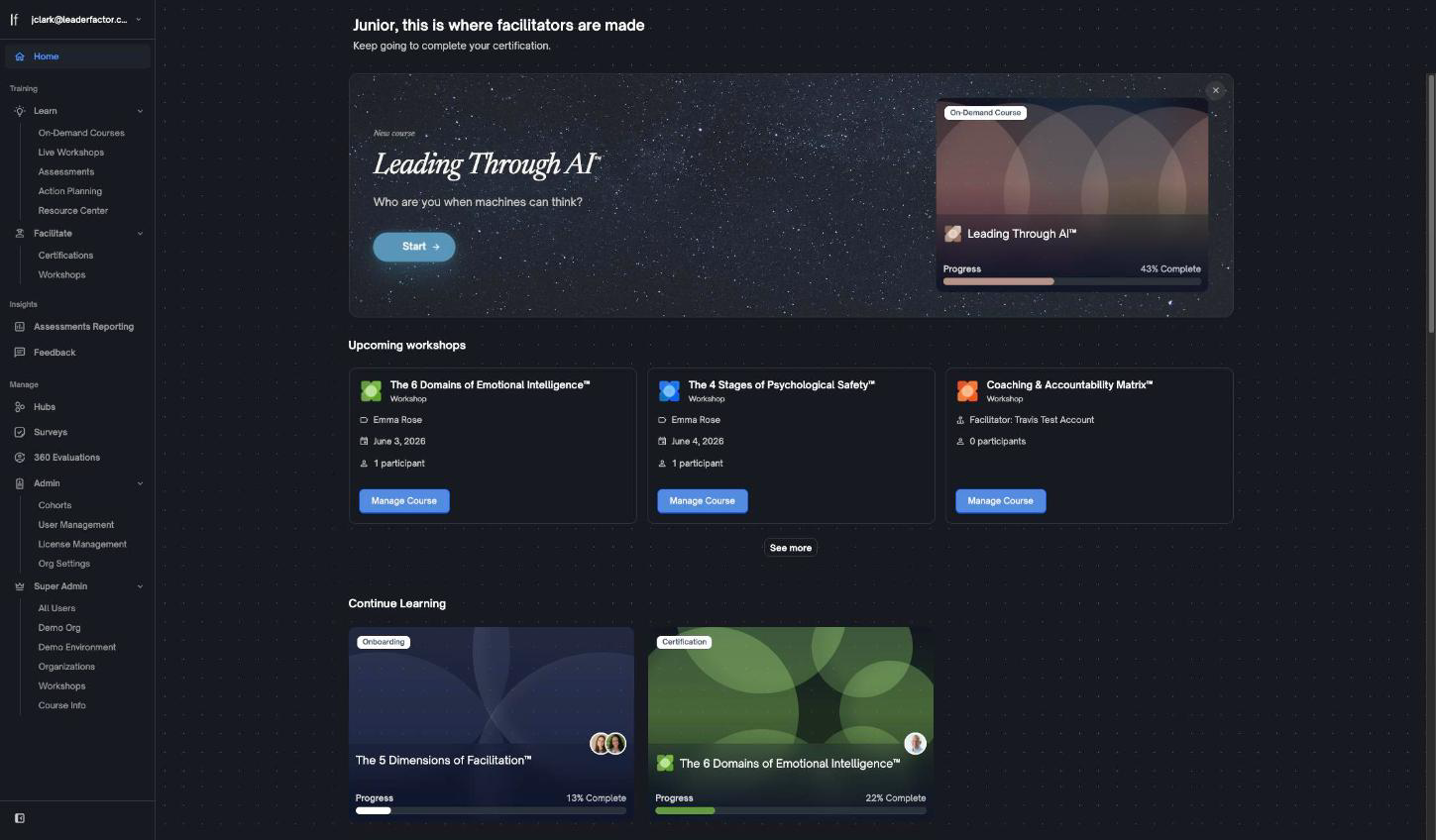 The learner home in the LeaderFactor platform
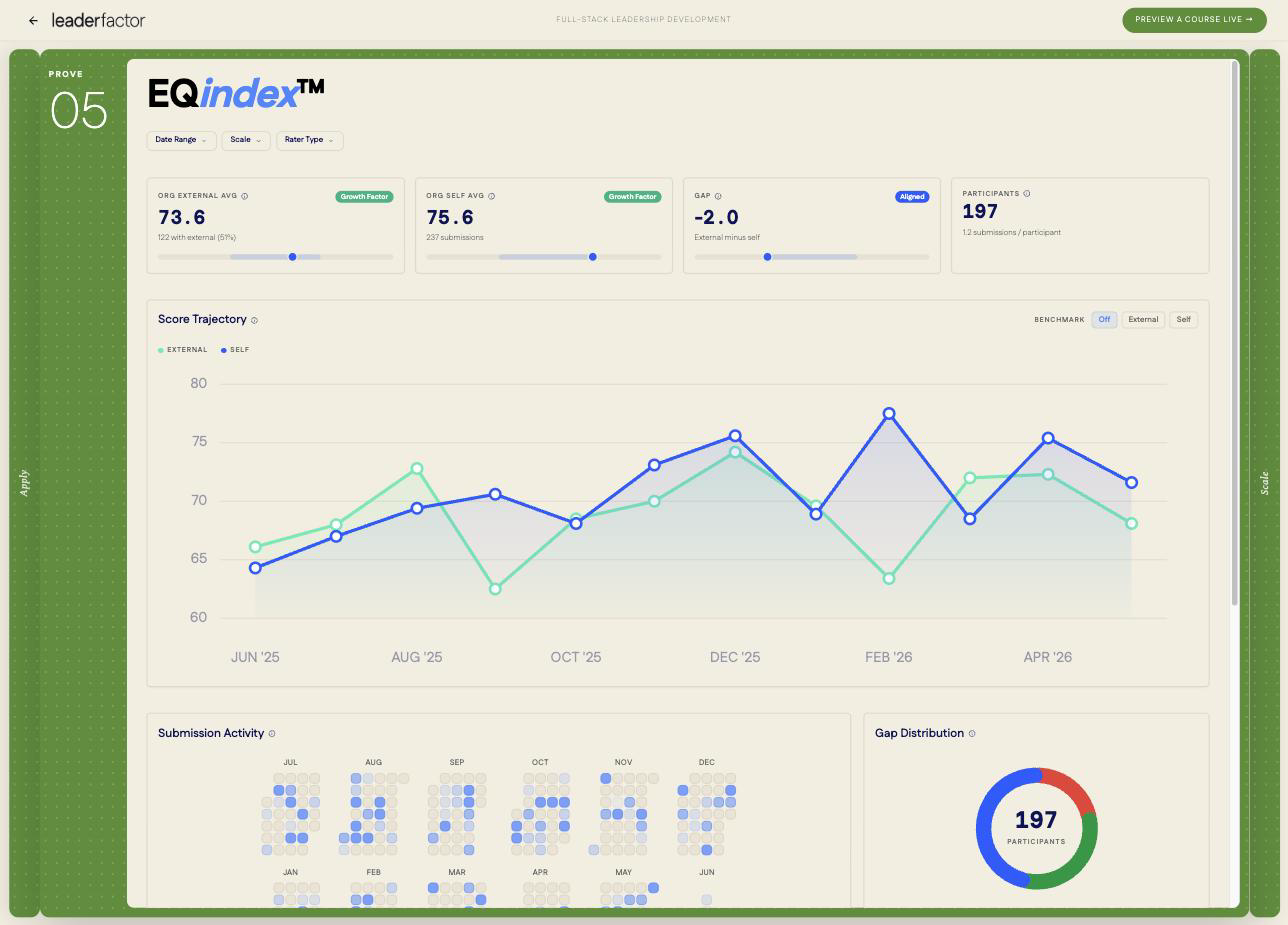 EQindex® re-measure
Screens from leaderfactor.app with sample data. Not client results.
Not sure this is the skill you need?
If a leader lands fine with people but delegation and follow-through keep slipping, the gap is Coaching & Accountability, not emotional intelligence. If the problem is the whole room going quiet rather than one leader's weather, start with Psychological Safety.
See the Coaching & Accountability programFrequently asked questions
- What is emotional intelligence training for leaders?
- Emotional intelligence training for leaders is a structured program that teaches how to recognize, regulate, and work with emotions in yourself and in the people you lead, then has you practice specific behaviors under real pressure. Good programs measure before and after, because emotional intelligence is a learnable skill and the movement in the score is the evidence.
- What should an emotional intelligence training program cover?
- Two theaters. The internal theater covers Self-Awareness, Self-Regard, and Self-Management, the work a leader does on themselves. The external theater covers Social Awareness, Social Regard, and Social Management, the work a leader does with others. Programs that skip regard, the beliefs about worth that drive behavior, produce leaders who perform the skills without the intent behind them.
- Can emotional intelligence actually be trained?
- Yes. Emotional intelligence is not a fixed trait. It is a function of what you believe, what you know, and what you do, and all three move with deliberate practice. The reliable pattern is a baseline assessment, training on the framework, 60 to 90 days of practicing one or two chosen skills in real work, and a retest to show what changed.
- How long does emotional intelligence training take?
- The learning takes four modules. The change takes about 60 to 90 days after, which is roughly how long new habits need to hold under pressure. Programs that end at the last session measure attendance. Programs that build in the practice window and a re-measure can show whether a leader's behavior moved.
- How do you measure whether emotional intelligence training worked?
- Run the same instrument before and after. LeaderFactor's EQindex® scores all six domains and the thirty skills beneath them at baseline and again after the practice window. Adding the multi-rater option shows the gap between how a leader rates themselves and how their team experiences them, which is usually the number worth acting on.
Fix your delivery system.
See the program run in a free one-hour Skill Preview, assessment included. Or talk with us about a cohort for your leaders.
or start with the free guide, The EQindex field guide →