





Psychological safety at home: the 4 stages applied to family life
Psychological safety at home is a family culture of rewarded vulnerability. Learn how the 4 stages build trust, open communication, and belonging at home.
Psychological safety at home is a family environment where every member feels safe to express their thoughts, emotions, mistakes, and concerns without fear of judgment, rejection, or punishment. LeaderFactor defines psychological safety as a culture of rewarded vulnerability, and that definition holds just as well at the dinner table as it does in a boardroom. In a psychologically safe home, when someone takes an interpersonal risk, admitting they were wrong, sharing a fear, asking for help, the family rewards that vulnerability instead of punishing it. Over time, that pattern is what turns a household into a place where people can be their authentic selves.
Most articles treat psychological safety as a workplace idea that we’re borrowing for the family. Dr. Timothy R. Clark, whose research underpins The 4 Stages of Psychological Safety™, argues the opposite: psychological safety was never a workplace concept in the first place. Wherever there are humans, there is culture, and culture is simply the way we interact. So psychological safety lives in every place humans interact, the home, the classroom, the friend group, the neighborhood gathering. The workplace is just one social unit among many. Your home is another, and arguably the one that matters most.
What does psychological safety at home actually mean?
Psychological safety at home means each person carries a quiet assurance that being vulnerable with their family will be met with reward, not punishment. It rests on the same central mechanism LeaderFactor teaches leaders: you model vulnerability yourself, and you reward the vulnerability of others. There is no workaround and no shortcut, at work or at home. A parent who wants an open teenager has to be openable first.
Humans are wired for this. When people come together in any social setting, they instinctively run threat detection, asking a single question: am I safe here? The answer governs behavior. A family member who concludes they are safe offers a performance response, they engage, contribute, and bring their real selves. One who concludes they are unsafe offers a fear response aimed at self-protection, they withdraw, go quiet, and manage risk. Neurologically, rewarded vulnerability activates the brain’s reward centers and releases discretionary effort; punished vulnerability activates the pain centers and freezes it, whether the person is in a meeting or at the kitchen table.
Is psychological safety the same as trust in relationships?
No, and the distinction matters more in personal relationships than almost anywhere else. Trust is the broad belief in the reliability of something or someone. Psychological safety is one specific component of trust: your assurance that when you engage in vulnerable behavior, the other person will reward, not punish, that behavior. You can trust a world-class surgeon’s competence completely while feeling no psychological safety about their bedside manner. Trust without safety is common, and families are full of it, you can trust a relative to always show up and still not feel safe being emotionally honest with them.
This is why “we have a close family” is not the same as “we have a psychologically safe family.” Closeness and reliability are real, but safety is measured by what happens the moment someone risks something, and whether it gets rewarded. For more on the boundary between the two, see psychological safety vs. trust.
What are the 4 stages of psychological safety at home?
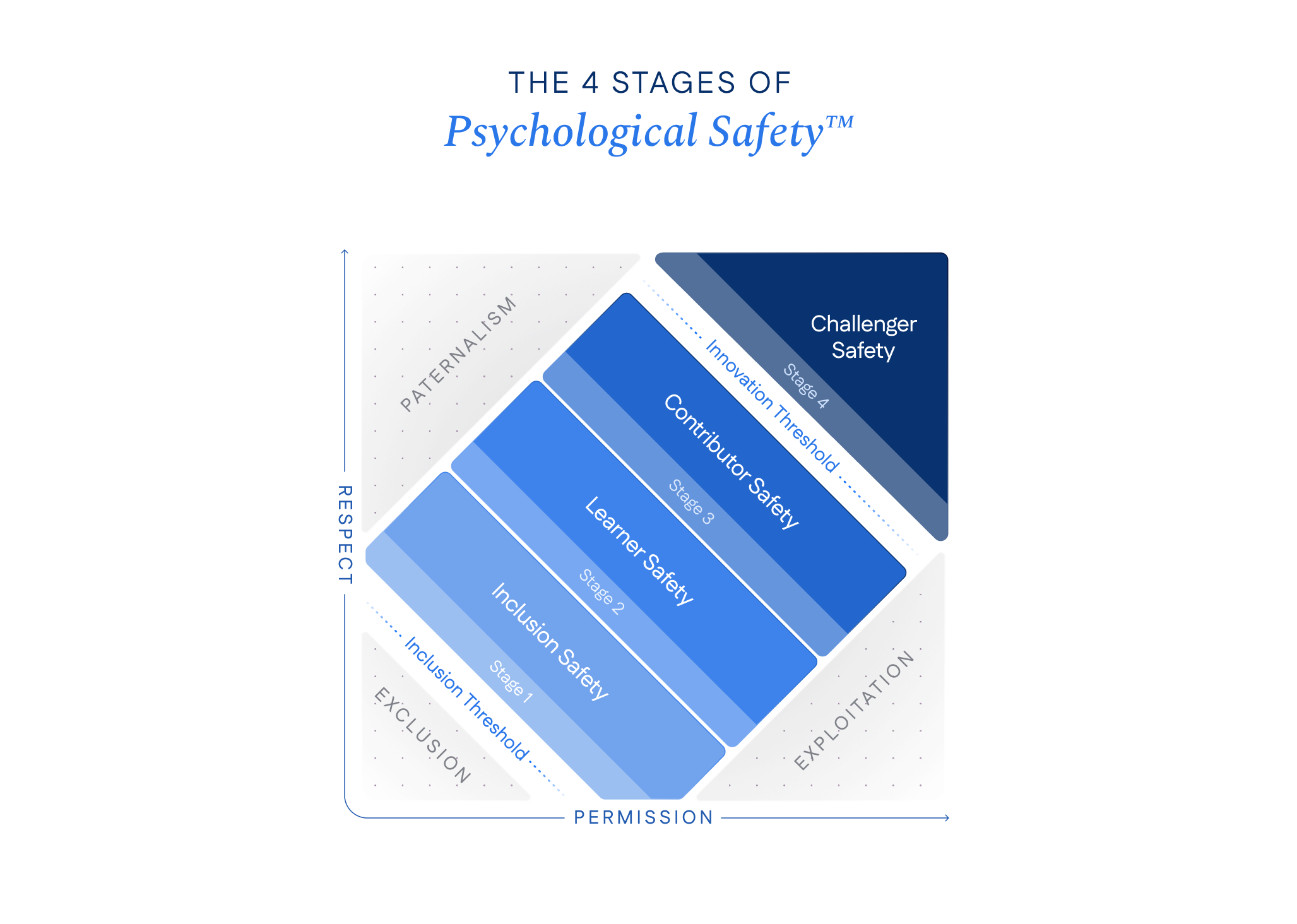
Dr. Timothy R. Clark’s framework moves through four stages, each satisfying a different human need and each building on the one before it. In a family, the stages progress in exactly the same order they do on a team. The first two are owed to every member simply for being part of the family; the second two are earned through a social exchange. Here is what each stage looks like at home.
Stage 1 — Inclusion Safety: can I be my authentic self?
Inclusion Safety is the sense that you belong and are accepted for who you are. At home it answers the question, can I be my authentic self here? When someone answers no, it usually means their authentic self has been punished often enough that they stopped offering it. Instead they armor, mask, modulate, or code-switch, showing a version of themselves that no longer gets punished. The gap between a person’s authentic self and the self who actually shows up at dinner is a direct readout of how their vulnerability has been treated over time.
Inclusion is punished in small, common, disproportionately damaging ways: interrupting, ignoring what someone said, making a family member the butt of a joke, dismissing emotions, refusing to accept a friend or partner they bring home, holding grudges, or reacting poorly to mistakes. Rarely fatal in one instance, corrosive as a repeated pattern. The social exchange for inclusion is generous: if you’re human and harmless, you’re in. It’s owed, not earned.
Stage 2 — Learner Safety: is it safe to ask, try, and fail?
Learner Safety is the confidence to engage in learning, asking questions, trying new things, admitting you don’t know, making mistakes, without being embarrassed or shut down. The social exchange is encouragement to learn in exchange for engagement in the learning process, and the encouragement has to come first. A child or partner coming out of a less safe environment won’t start asking questions and risking mistakes until someone visibly makes it safe to.
The fastest way to kill Learner Safety is a single dismissive response at the wrong moment. The fastest way to build it is counterintuitive: ask a question in return instead of giving the answer, because giving the answer often stops learning, it ends the exploration and keeps ownership with you. Some of the best parents ask far more questions than they answer, and they ask with audible enthusiasm, because enthusiasm signals shared discovery. Watch the first thing you say when a child shares their day. “What did you score?” teaches them you value the score; “what was the most interesting part?” teaches them you value the learning.
Stage 3 — Contributor Safety: is it safe to add value and have autonomy?
Contributor Safety is the freedom to make a meaningful contribution with an appropriate level of autonomy, role clarity, and support. This is where the family crosses the performance threshold: unlike Inclusion Safety and Learner Safety, Contributor Safety is earned through the exchange of autonomy with guidance in exchange for results. Different track records get different levels of autonomy, and that’s healthy, a little autonomy earns a little result, which earns a little more autonomy.
The drive to contribute is innate, not taught. A two-year-old pushing your hand away to do it herself, “me do it”, is Contributor Safety in its rawest form. Deny people the chance to contribute and they stagnate, because no one likes to be a passenger. At home, contributor vulnerability shows up as accepting praise, asking for more responsibility, holding a family member accountable, letting go so someone else can reach their potential, and, hardest of all, restraining from offering unnecessary feedback. Constantly weighing in adds too much value; it hamstrings the very development you’re trying to encourage.
Stage 4 — Challenger Safety: is it safe to be honest with each other?
Challenger Safety is the freedom to challenge the status quo, and to be candid, without fear of repercussion. It sits above the innovation threshold because growth requires deviation, and deviation requires someone willing to say the hard thing. The social exchange is air cover in exchange for candor. In a family this is the hardest stage by far, because personal candor is usually pointed directly at you, at your parenting, your habits, your blind spots, not at a project or a decision. Squaring up to feedback about yourself is dramatically harder, and dramatically more important.
The most useful diagnostic is your own reaction. Notice when you get irritated, defensive, territorial, or triggered, then follow the symptom back to its source, because your emotional response is the rate-limiter on Challenger Safety at home. From there you have exactly two choices: change your behavior, or change your belief that you need to change your behavior. The second is easier and more dangerous, so beware the soothing stories you tell yourself.
How do you build psychological safety in your family?
You build it by making acts of vulnerability safe, repeatedly and predictably, until being open is the path of least resistance. LeaderFactor teaches a simple behavioral tool for exactly this, the LIVE Model, and it works as well across a dinner table as across a conference table:
- Look for acts of vulnerability happening around you all day, a kid admitting a bad grade, a partner voicing a worry.
- Identify them in real time, without lag, the reward has to land close to the risk.
- Validate the person so they feel seen, heard, and understood.
- Encourage the behavior so they do it again.
The point is to normalize the reward pattern so the next risk-reward calculation is easy. A huge part of trust is predictability: when your family knows with high confidence how you’ll respond to honesty, they’ll keep bringing it. Your batting average matters more than any single moment.
A companion practice is the Ladder of Vulnerability. Different people perceive vulnerability differently, what feels routine to you may feel exposed to your partner or child. Naming it out loud, “here’s what feels vulnerable for me, here’s what feels vulnerable for you”, is by nature a vulnerable conversation, which is part of its power. It’s one of the highest-leverage conversations two people in any relationship can have.
What gets in the way of psychological safety at home?
The biggest obstacle is inherited: the path of least resistance to power throughout human history has been coercion, crushing people into submission rather than persuading them. Each of us carries the fingerprints of that history, and un-installing them takes intent. In practice, the barriers show up as fear, criticism, dismissiveness, and unhealed past hurts that quietly teach family members it isn’t safe to be open. (For the workplace analog, see barriers to psychological safety.)
Two clarifications keep families from misapplying the idea. First, psychological safety is not niceness. A family can paint a thin layer of nice over a thick layer of fear and mistake the quiet for safety, real safety makes hard honesty possible, not impossible. Second, psychological safety is not a shield from accountability. Rewarding vulnerability doesn’t mean removing consequences; it means making it safe to own the truth so accountability can actually happen.
Finally, expect a knowing-doing gap. Even people who cherish their relationships damage them sometimes. The measure of progress isn’t perfection; it’s catching it in real time, apologizing, and going back to deliberate practice. As Clark puts it, a life is about relationships, so if you’re not doing relationships right, you’re not doing life right, which is exactly why this work is worth it.
Where to go next
Psychological safety at home isn’t a softer version of the workplace concept, it’s the same concept in its most consequential setting. Start with one stage, most families have the most room at the top, in learner and Challenger Safety, and use the LIVE Model to make one act of vulnerability this week land with reward instead of punishment.
To go deeper, read the full definition of psychological safety or unpack how safety differs from trust in relationships.
Frequently asked questions
- What is psychological safety at home?
- Psychological safety at home is a family environment where each person can express thoughts, emotions, and mistakes without fear of judgment, rejection, or punishment. It is a culture of rewarded vulnerability applied to family life instead of work. When someone takes an interpersonal risk, like admitting a mistake, the family rewards that vulnerability rather than punishing it.
- How do you create psychological safety in a family?
- You create it through one mechanism: model vulnerability yourself, then reward the vulnerability of others. Practically, that means listening without judgment, apologizing when you get it wrong, asking questions instead of giving answers, and treating mistakes as learning. Do this consistently and family members learn that being open is safe, so they keep doing it.
- Is psychological safety only for the workplace?
- No. Psychological safety exists wherever humans interact, because culture is simply the way people interact and every group forms one. Dr. Timothy R. Clark frames it as a human need that spans all social units, homes, friendships, schools, and teams. The same four stages, inclusion, learner, contributor, and Challenger Safety, apply in a family just as they do at work.
- How is psychological safety different from trust in relationships?
- Trust is the broad belief in someone's reliability. Psychological safety is one component of trust: your assurance that when you act vulnerably, the other person will reward rather than punish you. You can trust a person's competence while feeling no safety being vulnerable with them, which is why the two are related but not the same.
- Why does psychological safety matter for children and teens?
- Children and teens read whether it is safe to be themselves from how their vulnerability is treated at home. When parents reward openness, ask enthusiastic questions, and let kids do things themselves, children build confidence, learning agility, and self-worth. When vulnerability is punished, they armor up and hide their authentic selves, which follows them into adulthood.