





The components of psychological safety, explained
The components of psychological safety at work — the two axes it's built on, its four stages, and the mechanism that produces it, per LeaderFactor's model.
The components of psychological safety are the parts that combine to make a team feel safe: two underlying axes — respect and permission — that build into four progressive stages of safety, all produced by a single mechanism called rewarded vulnerability. LeaderFactor defines psychological safety as a culture of rewarded vulnerability, where people share the belief that they can take interpersonal risks — asking a question, admitting a mistake, challenging a decision — without fear of being embarrassed, marginalized, or punished. Understanding the components matters because “be more open” is not an instruction anyone can act on; the components tell you what to build and in what order.
Most explanations of this topic list loose ingredients — trust, respect, open communication, a learning culture — as if they were interchangeable. They aren’t. Some of those are the raw material, some are the structure the material builds into, and one is the mechanism that turns material into structure. This page separates the three so you can see how psychological safety is actually assembled.
What are the two building blocks of psychological safety?
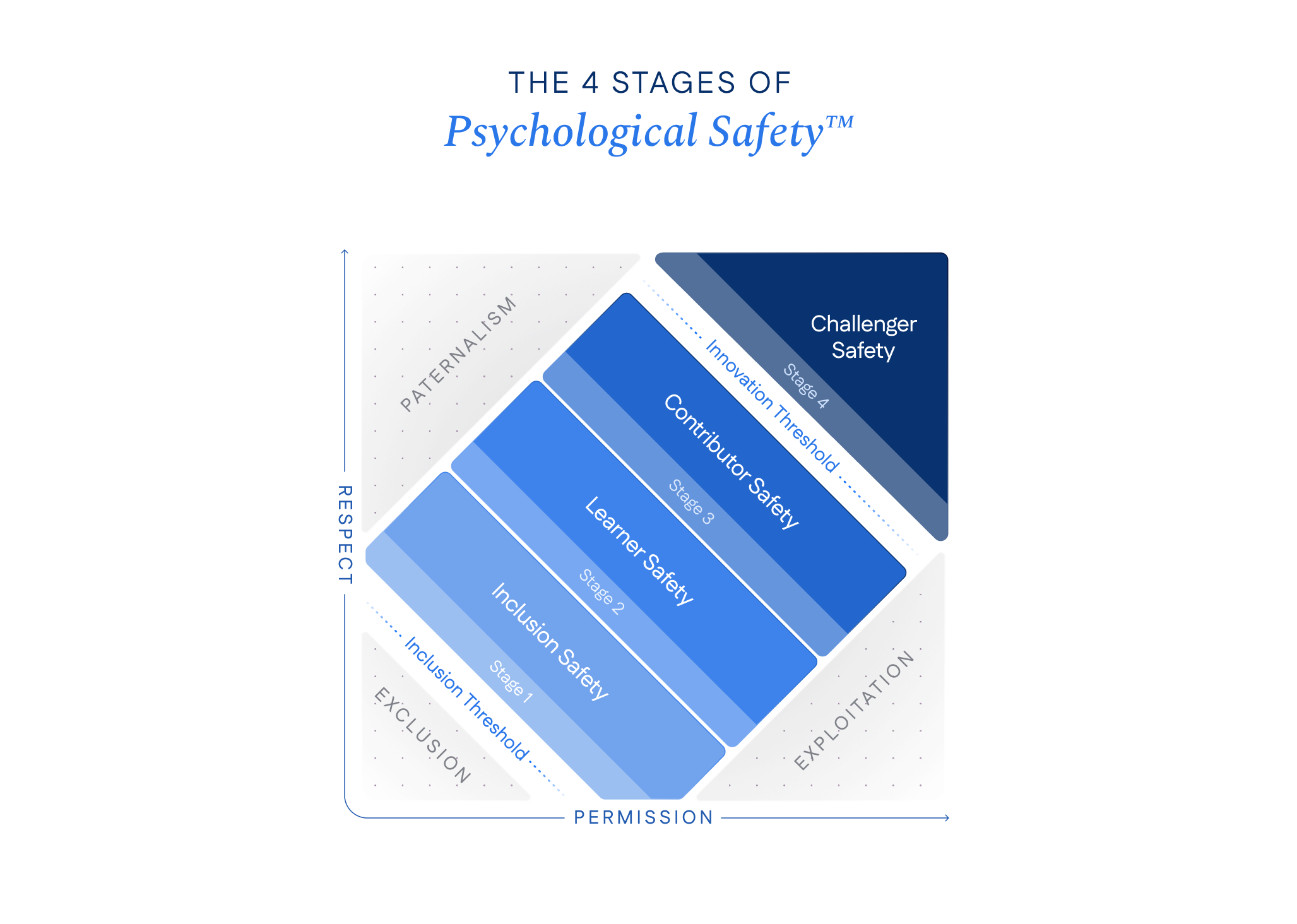
The two foundational components are respect and permission — the axes psychological safety lives at the intersection of. Respect is how much you value someone as a human being. Permission is how much latitude you give them to participate, contribute, and act. Neither is binary; each runs from low to high, and psychological safety is a matter of degree along both.
Why two axes instead of one? Because respect alone doesn’t produce safety, and permission alone doesn’t either — and the failures make that obvious. When you map high and low levels of each against the other, two well-known dysfunctions fall out of the combinations:
- Paternalism — high respect, low permission. The well-meaning micromanager who says, in effect, “I care about you, now don’t touch anything.” The leader becomes the obstacle, holding capable people back out of benevolence. It looks warm and feels safe on the surface, but it starves people of the permission to actually contribute.
- Exploitation — low respect, high permission. Lots of latitude, no regard for the person. The motive is to extract value: crediting the output while devaluing the human behind it. This runs from subtle (stealing credit, overloading a strong performer) to overt (bullying, public shaming).
Psychological safety is what exists in the remaining quadrant — where respect and permission are both high. That is why “just be respectful” or “just give people freedom” each fail on their own. You need both dials turned up together, and the four stages describe what that looks like as it deepens.
What are the four stages of psychological safety?
The four stages are the structural components — the progression that respect and permission build into as a team develops. LeaderFactor’s 4 Stages of Psychological Safety™ model, developed by Dr. Timothy R. Clark, names them in the sequence people actually experience, because each satisfies a different, escalating human need. A team begins in a state of exclusion — strangers who’ve never worked together — and crosses an inclusion threshold into stage one as inclusive norms emerge.
Stage 1 — Inclusion safety
Inclusion safety is the sense that you’re accepted and belong. It’s the first stage because global survey research is consistent across demographics and cultures: the first thing people need before they’ll risk anything is to be included. It’s the foundation the other three stages rest on — a team that hasn’t cleared this stage has nothing to build on.
Stage 2 — Learner safety
Learner safety is feeling safe to engage in the learning process — asking a question, trying something new, asking for help, making a mistake — without being embarrassed or punished. These are all acts of learning vulnerability, and stage two is the environment where they get rewarded rather than penalized. It satisfies the human need to learn, grow, and develop mastery.
Stage 3 — Contributor safety
Contributor safety is being given the chance to make a meaningful contribution, which in practice means an appropriate level of autonomy paired with role clarity, guidance, and support. It satisfies the need to contribute and have some independence in doing it. The balance matters: too little support is neglect, too much control is the paternalism trap from the previous section.
Stage 4 — Challenger safety
Challenger safety is feeling safe to challenge the status quo — to voice dissent, propose alternatives, and question how things are done — without fear of reprisal. It sits past what LeaderFactor calls the innovation threshold, because this is the realm where innovation actually happens. It’s the culminating stage and the hardest to reach, which is why so many teams stall out just short of it, comfortable but never quite candid. (For the fuller contrast, see psychological safety vs. trust.)
What is the mechanism that creates psychological safety?
The mechanism is rewarded vulnerability — and it’s the component most explanations skip entirely. Respect and permission are the axes; the four stages are the structure; rewarded vulnerability is the engine that produces all of it. LeaderFactor sums up the whole construct in five words: a culture of rewarded vulnerability. There is no workaround, no back door, no shortcut — this is how safety gets built.
It works because of how humans are wired. In any social setting we run continuous threat detection — reading the room to answer one question: Am I safe here? The answer governs our behavior. Conclude you’re safe and you offer a performance response: you jump in, participate eagerly, try to add value. Conclude you’re not and you offer a fear response: you withdraw, self-censor, and manage personal risk — the goal shifts from adding value to simply surviving. That difference isn’t small; it’s the difference between a team’s best thinking and its silence.
The mechanism itself has just two parts, and it belongs to the leader:
- Model vulnerability yourself — go first. Admit what you don’t know, own a mistake, ask for help in front of the team.
- Reward the vulnerability of others — when someone else takes an interpersonal risk, respond in a way that makes them glad they did, not sorry.
Do those two things consistently and you move a team up the stages. Fail to, and you get punished vulnerability — where taking a risk activates the brain’s pain centers, and people learn to keep their heads down.
Why isn’t “trust” or “open communication” the main component?
Because trust and open communication are outcomes and inputs around the edges of psychological safety, not its structural core. This is where most lists go wrong, so it’s worth being precise:
- Respect is a genuine component — it’s one of the two axes. But respect on its own, without permission, produces paternalism rather than safety, which is why it can’t be the whole answer.
- Trust is closely related but distinct. Trust is a judgment you make about a specific person over time; psychological safety is a property of the group climate you’re in right now. You can trust a colleague and still not feel safe speaking up in the room — the two travel together but aren’t the same thing.
- Open communication, a speak-up culture, a feedback culture — these are what psychological safety produces. A speak-up culture is largely challenger safety in action; a feedback culture is largely learner safety in action. Naming them as separate “components” describes the symptoms while missing the source.
Keeping the causes (respect, permission, rewarded vulnerability) separate from the effects (open communication, candor, innovation) is what lets you fix the right thing. If people aren’t speaking up, the lever isn’t a “communication initiative” — it’s the specific stage of safety that’s missing.
What psychological safety is not
Naming the real components also means ruling out the counterfeits, because psychological safety is one of the most misapplied ideas in management. It is not a shield from accountability, and it is not coddling — you can hold people to high standards and keep them safe; in fact you have to. It is not consensus decision-making (it doesn’t hand everyone a vote), not mere niceness (a thin layer of nice painted over a thick layer of fear is the opposite of safety), and not unearned autonomy (independence is still earned through performance). And it can’t be declared into existence — a leader who announces “we’re now psychologically safe” has mistaken words for the conditions that actually take work to build.
How do you measure the components of psychological safety?
You measure the components with a validated instrument that scores each one separately, so you know which part of the architecture is weak. LeaderFactor uses PSindex®, a psychometrically validated, multi-rater survey built directly on the four-stage framework. Its structure mirrors the components:
- Four subscales, one per stage — 12 items total, three items measuring each of inclusion, learner, contributor, and challenger safety, so every component gets its own score.
- Developed to formal standards — PSindex® follows the American Educational Research Association (AERA) Joint Standards for educational and psychological testing, with reliability estimated via Cronbach’s alpha.
- Scored by behavioral zone — responses fall into a Blue Zone (a consistent pattern of rewarded vulnerability), a Neutral Zone (inconsistent), or a Red Zone (consistently punished vulnerability). A team’s score is the Blue Zone percentage minus the Red Zone percentage, on a scale from -100 to +100.
- Measured at the intact-team level — the team is the smallest divisible unit of culture, so that’s where the reading is most meaningful.
Because each stage is scored on its own, the results tell you which component is missing — a team can be strong on inclusion safety yet weak on challenger safety, which points straight to the work. For the fuller method, see how to measure psychological safety.
Putting the components together
Psychological safety isn’t a checklist of feel-good ingredients; it’s a structure with a source. The two axes — respect and permission — are the raw material. The four stages — inclusion, learner, contributor, and challenger safety — are what that material builds into, in sequence, each satisfying a deeper human need than the last. And rewarded vulnerability — modeling vulnerability and rewarding it in others — is the single mechanism that turns the material into the structure. Get the mechanism right, build the stages in order, and the outcomes everyone actually wants — candor, learning, contribution, innovation — follow. To go deeper on the model and start moving your team through the stages, visit the Psychological Safety skill page, or see the benefits of psychological safety to understand what’s at stake when the components are in place.
Frequently asked questions
- What are the components of psychological safety?
- Psychological safety has two building-block axes — respect and permission — that combine into a progression of four stages: inclusion safety, learner safety, contributor safety, and challenger safety. The mechanism that produces all of it is rewarded vulnerability: modeling vulnerability yourself and rewarding it in others.
- What is the mechanism that creates psychological safety?
- The mechanism is rewarded vulnerability. Respect and permission are the axes, the four stages are the structure, and rewarded vulnerability is the engine that produces both. It has two parts and belongs to the leader: model vulnerability yourself, then reward the vulnerability of others. There is no shortcut.
- Are respect and trust components of psychological safety?
- Respect is one of the two axes psychological safety is built on; the other is permission. Trust is closely related but distinct — trust is a judgment about another person over time, while psychological safety is a property of the group environment. High respect paired with low permission produces paternalism, not safety, so respect alone is not enough.
- What is the difference between contributor safety and challenger safety?
- Contributor safety gives people autonomy and role clarity to do meaningful work — the freedom to perform. Challenger safety goes further, making it safe to question the status quo, voice dissent, and propose alternatives without fear of reprisal. Challenger safety sits past the innovation threshold, which is why it is the component most tied to innovation.
- How do you measure the components of psychological safety?
- LeaderFactor measures the components with PSindex®, a psychometrically validated, multi-rater survey with a three-item subscale for each of the four stages. It scores a team from -100 to +100 by subtracting the percentage of unsafe (Red Zone) responses from safe (Blue Zone) responses, revealing exactly which component is weakest.