







Stage 4: Challenger Safety
Challenger safety is where innovation happens. The social exchange is air cover for candor: intellectual friction up, social friction down.
Now we’ve come to Stage 4: Challenger Safety — the culminating stage and the ultimate expression of psychological safety. Here’s the central question: can I challenge the status quo without retaliation, retribution, jeopardizing my reputation, or putting my career on the line?
You know the meeting after the meeting — the one where everyone finally says what they think. 85% of employees withhold feedback out of fear. Silence is expensive, but silence is safe.
Challenger safety satisfies the basic human need to challenge and improve. You feel safe to speak up when you think there’s a need or opportunity to improve. For most people, this is the biggest single act of vulnerability. It’s scary, and there’s a lot at stake. We can’t expect people to simply muscle through that fear. And remember: disagreement is not disloyalty. Conditional loyalty is just conformity.
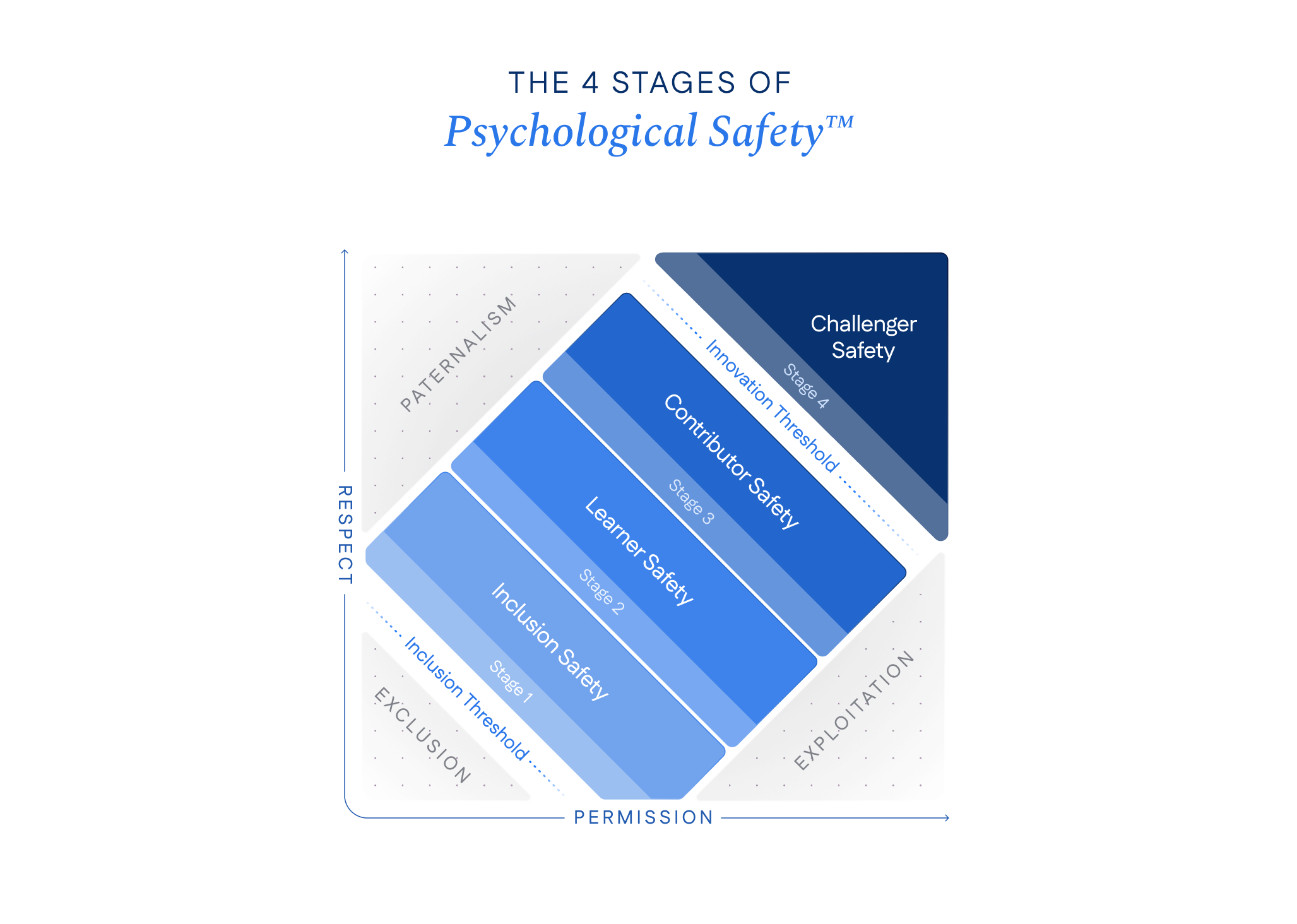
The threshold of innovation
When we get to challenger safety, we cross the threshold of innovation. Challenger safety is where innovation happens. Think about this for a minute. Innovation requires deviation. Deviation from what? From the status quo. What percentage of the time? 100 percent of the time. Even the smallest marginal improvement requires that we deviate from the status quo.
So what are the defining characteristics of a team that is demonstrating challenger safety? Here are a few patterns we see. Your team will be showing divergent thinking and constructive dissent — dissent isn’t just tolerated, it’s not just accommodated. It’s welcomed. It’s rewarded. You’re going to see a very high tolerance for candor. People are given a license to disagree, and they use it. And finally, you’ll see a pattern of creative abrasion: ideas colliding, rubbing against each other.
Now step back and think about why we need these patterns. Divergent thinking. Constructive dissent. Tolerance for candor. Creative abrasion. Why? Because they’re the raw material of innovation. How else can we solve difficult problems, create new solutions, make breakthroughs?
Air cover for candor
The social exchange for challenger safety is air cover for candor. Who provides the air cover? The team does. The members of the team give each other air cover in exchange for candor. If the air cover isn’t there, people are very reluctant to be candid. So this is the enabling condition: protect me when I’m candid — when I’m engaging in creative abrasion, constructive dissent, and divergent thinking. I need protection for those vulnerable activities.
Intellectual friction up, social friction down
The defining characteristic of teams that move all the way to challenger safety is that they can do two things at once: increase intellectual friction to very high levels, and at the same time decrease social friction to very low levels.
Why? The intellectual friction is what allows you to innovate. It’s what allows you to ideate, to have hard-hitting debate, to weigh issues on their merits and have a real idea meritocracy. But what happens when the intellectual friction goes high? There’s a tendency for the social friction to rise right along with it. And there’s the problem. At some point, the social friction will shut down the intellectual friction. Social friction is the mortal enemy of intellectual friction. The two don’t coexist well.
So on teams that achieve challenger safety, they keep the intellectual friction up and the social friction down. How? This is the ultimate expression of psychological safety — where all of the stages come together and interact to produce the highest level of performance. You need superb emotional intelligence. You’ve got to let go of your ego defense mechanisms. You need to let go of your pride of authorship and bring humility to the team.
Your adaptive capacity
Let’s back up. Think about what teams and organizations do. They only do two things: they engage in execution, and they engage in innovation. Execution is creating and delivering value today, based on the business model, the allocation of resources, the strategy. Innovation is figuring out how you will create and deliver value tomorrow.
What happens if you can’t innovate? What if you only execute? You’re not going to be around very long. You’ll quickly become obsolete and irrelevant. Challenger safety becomes your adaptive capacity, as a team and as an organization. It’s what allows you to adapt to a dynamic, hypercompetitive, unforgiving environment. If your team is going to perform, innovate, and stay relevant, you need to create, nurture, and maintain challenger safety.
And one last thought. Challenger safety isn’t only about innovation in organizations. Think about the people in your life who can tell you the truth. Do they have air cover with you? When someone close to you challenges you, questions a decision, points out a blind spot — what do they get back?
Fear breaks the feedback loop. It’s true in the workplace, and it’s true at home.
If you’re using fear in your relationships, you will eventually bear the cost. You’ll stop getting the feedback you need, the input you need, the counsel you need. So give the people around you air cover for candor. It’s the highest compliment you can pay them, and they will pay you back.
Challenger Safety Failure Patterns
For challenger safety, respect looks like I invite dissent. Permission looks like I give them air cover. The exchange being tested is air cover in exchange for candor.
Challenger Safety Failure Patterns · Stage 04
The exchange being tested: air cover in exchange for candor.
Invitation without cover is paternalism — the trap: “Speaking up here is a trap.” Cover without invitation is exploitation: “They’d let me disagree. They just never ask.” Grant neither and someone goes silent: “I don’t say anything anymore.” If your team’s version of candor only happens in the meeting after the meeting, you know which quadrant you’re in.
Make it a practice
Begin with some honest self-reflection, because this stage asks the most of you. Do you allow the people around you to challenge you? Do you give them a license to disagree, and do they actually use it? Because if nobody ever challenges you, that’s not a sign that you’re right. It’s a sign that it isn’t safe. When someone gives you constructive feedback or suggests a different course of action, do you get defensive, or do you lean in? Do you maintain your poise and composure under pressure? Can you debate issues on their merits without resorting to personal criticism? These are tough questions. They’re meant to be.
Then pick one behavior that builds challenger safety and practice it every day. Remember: dissent isn’t something to tolerate. It’s something to reward.
This is the final article in a four-part series on The 4 Stages of Psychological Safety™. Previous: Stage 3: Contributor Safety. Start from the beginning: Stage 1: Inclusion Safety.
Ready to bring it to your team? Talk with us →