







Stage 1: Inclusion Safety
Inclusion safety is a human right. If you are human and harmless, you qualify. Why worth precedes worthiness, and how to apply a worth test on your team.
The first of The 4 Stages of Psychological Safety™ is Inclusion Safety, and the central question is this: do you feel included?
Inclusion safety satisfies the basic human need to be included, to feel accepted, and to belong. It means it’s not expensive to be yourself. You’re accepted for who you are, including your unique attributes and defining characteristics.
You know the thread where the real decisions happen — and you’re not on it. Nobody voted you out; the door just never opened. That’s what missing inclusion safety feels like. Now consider that someone is having that experience of you. Exclusion is rarely a verdict. It’s a hundred small defaults: who you greet, who you ask, who comes to mind.
Diversity is not inclusion
First, let’s distinguish between diversity and inclusion. They’re related concepts, but they are not the same thing. Diversity is a matter of makeup and composition. Inclusion is a matter of intent and behavior. Here’s what we see over and over again with teams and organizations: they make great strides to become more diverse, and that’s wonderful. But often, despite becoming more diverse, they’re no more inclusive as a consequence. They got half the job done. Without inclusion, the diversity will remain dormant.
Now go back in history with me. In 1869, the great social reformer Frederick Douglass gave a speech in Boston called “The Composite Nation.” In that speech, he said: “I know of no rights of race superior to the rights of humanity.” What’s he saying? His point was that our highest loyalty should be humanity. That’s how we create inclusion safety for all. If we elevate any human characteristic above humanity, we immediately begin to sow the seeds of division. And here’s what’s fascinating: Frederick Douglass is best known as an abolitionist, but in this case he was advocating for the citizenship rights of Chinese immigrants.
Worth precedes worthiness
The governing principle of inclusion safety is this: worth precedes worthiness. When it comes to basic inclusion, we should apply a worth test to each other, not a worthiness test. Inclusion should be based on our inherent worth as members of the human family. This means we don’t include or exclude each other based on personal attributes or characteristics, like race, gender, religion, age, education, or socioeconomic status. Too often, we apply worthiness tests instead. And that’s the problem.
Inclusion safety is not something you earn. It’s something you’re owed. It’s a human right.
The word entitlement is deliberate. So what should it take to qualify for inclusion safety? Two things. Be human, and be harmless. If you meet both criteria, you qualify. There is no other test.
If we apply worthiness tests to each other, we are not able to create and sustain inclusion safety. But if we apply a worth test to each other, based on membership in the human family, we can. When we compare and compete, we lose the ability to connect.
Inclusion Safety Failure Patterns
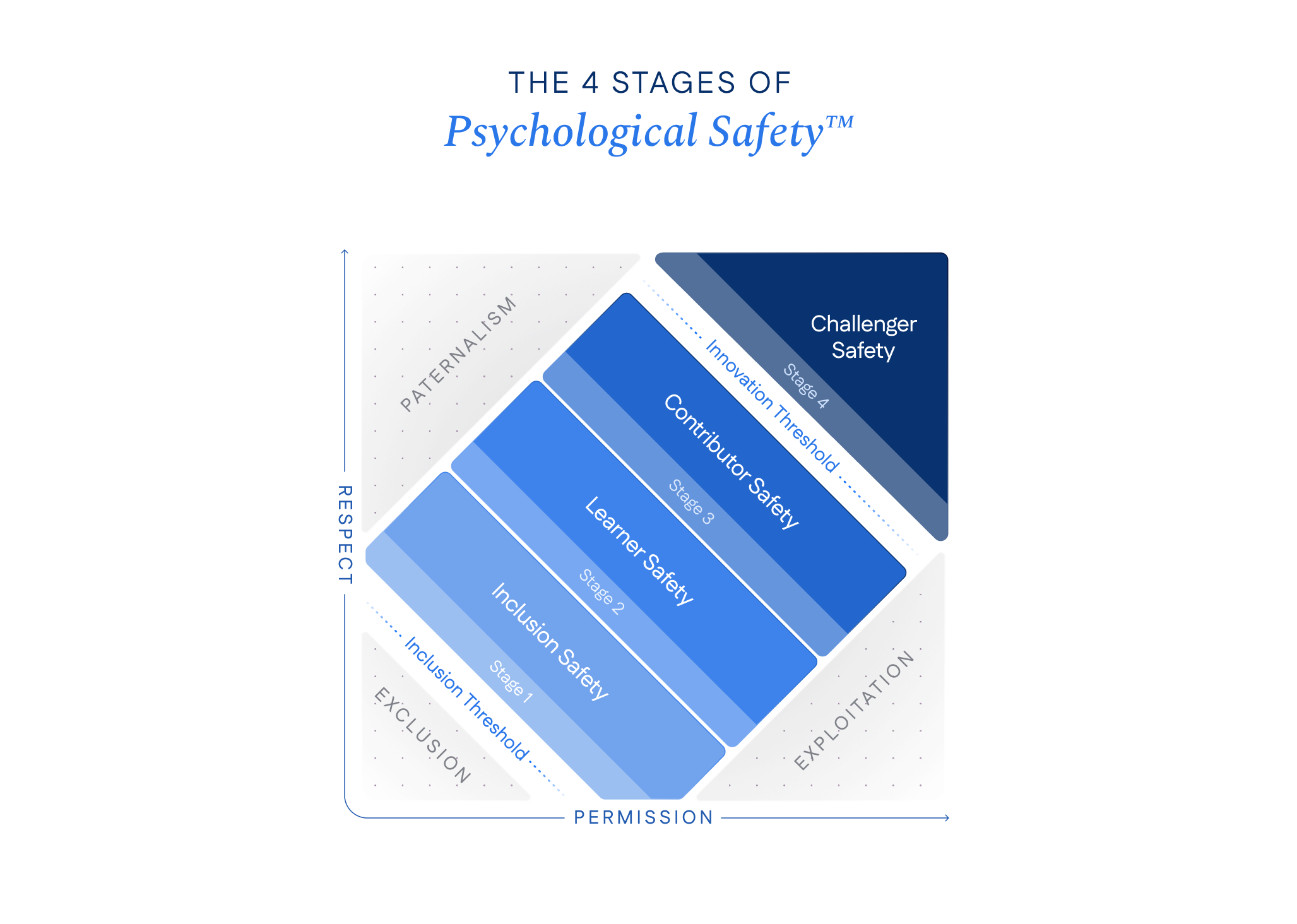
Inclusion safety is granted through two behaviors working together. Respect looks like I know them. Permission looks like I bring them in. The exchange being tested is inclusion in exchange for human status and the absence of harm — and the four combinations map the four experiences people have on your team.
Inclusion Safety Failure Patterns · Stage 01
The exchange being tested: inclusion in exchange for human status and the absence of harm.
Respect without permission is paternalism: “I’m liked here, but I’m not part of anything.” Permission without respect is exploitation: “I’m useful here, but nobody knows me.” Grant neither and someone is simply excluded: “I’m invisible here.” You don’t measure the inclusion safety you create by your intent. You measure it by what the people around you would say.
Are there ever grounds for exclusion? Yes — when someone threatens others with harm. That’s the only case. All other demographic, psychographic, and cultural differences are arbitrary distinctions. Are they important? They’re incredibly important. They’re the cherished sources of people’s identities. But they are not grounds for exclusion.
Make it a practice
How do you install inclusion safety? Apply a worth test to the people around you, and model and reward the behaviors that foster inclusion. Those behaviors involve asking, listening, inviting, and sharing. They draw people to you rather than push them away. They bridge differences rather than create them. They communicate respect and permission at the most fundamental level of human behavior.
Then pick one behavior — just one — to practice. Don’t pick the easiest one. Pick the one that matters, given what your team’s candor tells you. Model it and reinforce it every day until it becomes muscle memory. You’re a cultural architect. You either lead the way or get in the way.
This is the first article in a four-part series on The 4 Stages of Psychological Safety™. Next: Stage 2: Learner Safety.
Ready to bring it to your team? Talk with us →