







Stage 2: Learner Safety
Learner safety detaches fear from mistakes. High expectations, low fear — and why an emotionally bruised learner is a cognitively impaired learner.
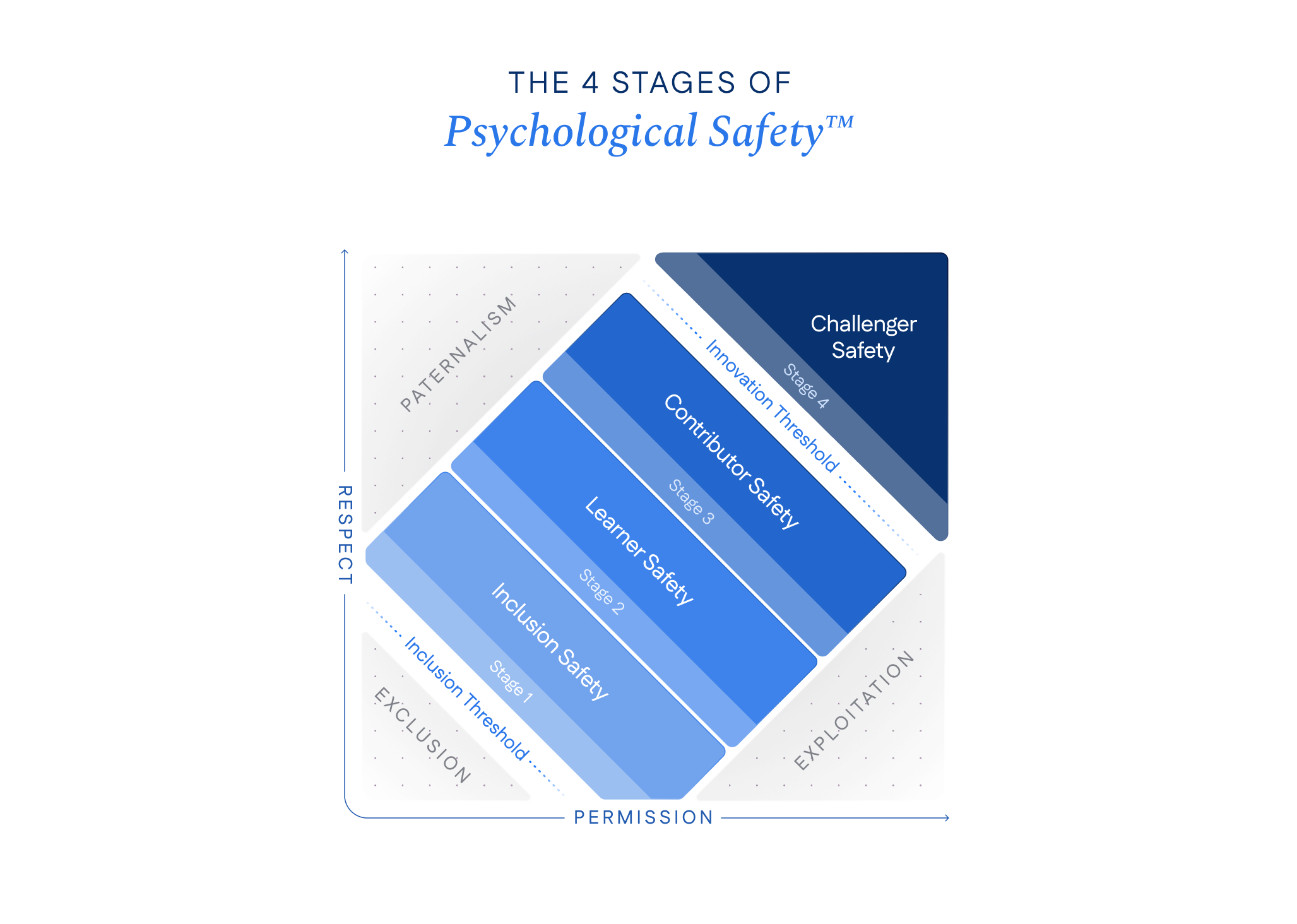
The second of The 4 Stages of Psychological Safety™ is Learner Safety, and the central question is this: do you feel safe to learn?
Think of the last question you swallowed. Most people can name the meeting where they learned to stop asking.
Learner safety satisfies the basic human need to learn, grow, and develop mastery. Rather than being embarrassed, marginalized, or punished in some way, you feel encouraged, rewarded, and safe when you engage in acts of learning vulnerability: asking questions, giving and receiving feedback, experimenting, even making mistakes. And here’s the flip: “I don’t punish questions” isn’t the standard. The question is what you build. What someone gets back in the first five seconds decides whether they bring you the next one.
The team goes first
Let’s talk about the social exchange for learner safety — the reciprocal relationship between you and the team. For Stage 2, it’s this: the team encourages your learning in exchange for you engaging in the learning process.
But who goes first? Does the team go first to encourage your learning, or do you go first and jump into the learning process? Here’s what the research shows: the team goes first. The team has a first-mover obligation and stewardship.
Why is that? Think about it. Can we assume that every new member of a team arrives ready to learn? The answer is no. Some people come from very difficult experiences. They’ve come out of toxic environments. They arrive as emotionally bruised learners. And what do we know about learning? Learning is both intellectual and emotional. You can’t separate the thinking brain from the feeling brain.
An emotionally bruised learner is a cognitively impaired learner. An emotionally empowered learner is a cognitively enabled learner.
So the operating assumption is that people don’t always arrive emotionally ready to learn. We encourage their learning first. Sometimes it’s going to take a little time before they’re ready to learn at capacity. From day one, we’re ready to nurture their learning.
Detach fear from mistakes
To foster learner safety, your job is to create an environment where you detach fear from mistakes. Fear is normally associated with mistakes, but it doesn’t have to be. On the best teams, they create a norm where the two come apart. Why? Because learning is fraught with risk. We all bring some level of inhibition and fear to the learning process. If we can divorce fear from mistakes, people jump into learning. They take learning risks because they know that if they make a mistake, they’ll be rewarded for the vulnerability, not punished for it.
Learner safety is not about lowering the bar. The pattern you’re looking for is high expectations, low fear. And this principle applies far beyond the workplace. Think about the learners in your home, in your family, in your community. They need the same thing.
Learner Safety Failure Patterns
For learner safety, respect looks like I invest in their growth. Permission looks like I let them get it wrong. The exchange being tested is encouragement in exchange for engagement.
Learner Safety Failure Patterns · Stage 02
The exchange being tested: encouragement in exchange for engagement.
Investment without permission is paternalism — the hovering mentor: “I only get to do what I can’t get wrong.” Permission without investment is exploitation — sink or swim: “I’m figuring this out completely alone.” Grant neither and someone lands in discouraged: “I stopped asking.” If any of these sound like something your team would say, that line is the work.
Make it a practice
As you take stock of the learner safety you create for others, ask yourself some questions. Do you model vulnerability in your own learning? Do you ask questions? Do you admit what you don’t know? Do you give feedback with candor and care, and do you receive it without getting defensive? When the people around you take learning risks, do you protect them in those moments? When someone brings you a question or a mistake, what do they get back from you? Do they leave feeling encouraged or discouraged? That’s your baseline.
Here’s something to keep in mind: you may not be doing anything to reduce learner safety. But that’s not the standard. The question is, what are you doing to build it?
Pick one behavior that builds learner safety and practice it — model it and reinforce it every day until it becomes muscle memory. Detach fear from mistakes, and watch people learn.
This is the second article in a four-part series on The 4 Stages of Psychological Safety™. Previous: Stage 1: Inclusion Safety. Next: Stage 3: Contributor Safety.
Ready to bring it to your team? Talk with us →