







Stage 3: Contributor Safety
Contributor safety is earned. The social exchange is autonomy with guidance in exchange for results — and three levels of accountability get you there.
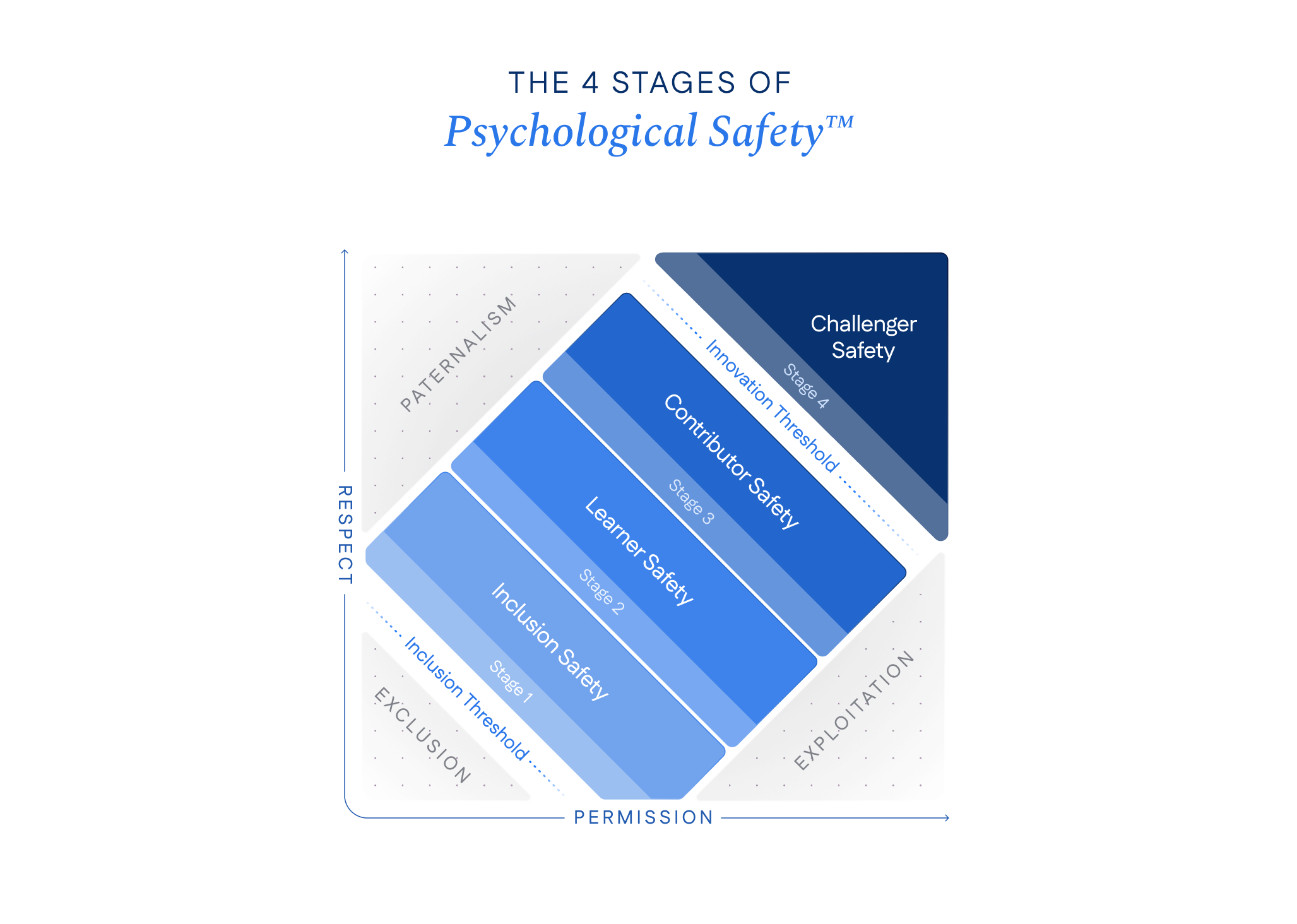
The third of The 4 Stages of Psychological Safety™ is Contributor Safety, and the central question is simple: do you feel safe to contribute?
Contributor safety satisfies the basic human need for choice and contribution. You feel safe, and you’re given the opportunity and role clarity to use your skills and abilities to make a difference. Human beings have a deep desire to make a difference. We want to find meaning and purpose in what we do. We want to carry our weight. We want to help, we want to perform, we want to do our part — and we don’t feel good about ourselves if we can’t.
We conducted an employee survey and asked a simple question: in life, generally, do you find more personal satisfaction in contribution or consumption? Can you guess how people responded? We were surprised at how stark the results were. 98 percent said contribution. Only 2 percent said consumption.
That’s why missing contributor safety hurts the way it does: being capable of more than anyone will hand you, or being given the work without the trust, every decision re-decided above you. And here’s the uncomfortable flip. From the inside, micromanagement feels like diligence. Praise is not empowerment either — the test isn’t how you talk about someone’s work, it’s what you hand them.
Autonomy is earned, not owed
The social exchange for contributor safety is autonomy with guidance in exchange for results. The team and the leader will give you an appropriate level of autonomy, with guidance, in exchange for your results.
This distinction is important. In Stage 1, we said inclusion safety is a human right — it’s not something you earn, it’s something you’re owed. By the time you get to Stage 3, this changes in a fundamental way. You have entered the realm of performance. You must deliver results. You don’t have a natural right to autonomy. You earn it through a track record of performance.
Explain the why. Delegate the how.
That’s the working rule. Autonomy doesn’t mean walking away and leaving someone to flounder — it means real latitude with guidance along the way, in exchange for results.
The three levels of accountability
So how do you earn contributor safety? You earn it by progressing through three levels of accountability.
The first level is task accountability. A task is a basic unit of work. We take our work, break it down into tasks, and assign them: “Pull the numbers for the monthly report.” The task has to be performed to standard, in quality and time, and reported back. Do that consistently and level one is mastered.
Then comes the second level: project and process accountability. A project is a cluster of tasks with a beginning, a middle, and an end. A process is a sequence of repeating tasks. Now the assignment grows: “Own the reporting cycle — gather the numbers, check them, publish them, every month.” A set of tasks that go together and repeat, delivered to standard. That’s level two.
The highest level is outcome accountability. Notice what changes: “Make sure leadership always knows where we stand. Make it happen.” At the outcome level, the terms of engagement change. You don’t walk through the details anymore. You step back down to the project or task level only by exception, if there’s a question or a problem. Otherwise, you stay at the outcome level.
Two perspectives
Think about this progression from two perspectives. First, from your own perspective as an individual: are you progressing from task, to project and process, to outcome accountability? And second, from the perspective of a leader: are you helping the people around you move through this progression?
Here’s the mistake we see all the time. We hold people at task level long after they’ve earned more. We explain the how when we should be delegating the how. We hover. And when we do that, we deny people the chance to develop.
The greatest gift you can give a capable person is a meaningful challenge and the room to meet it. Human beings have an innate need to use their knowledge, skills, and experience to contribute and make a difference. When people contribute in a meaningful way, they develop self-efficacy and self-worth, and they build the capacity for independent, high-level performance. This reaches beyond the workplace too. Think about what it means to give a young person, or anyone you lead, a real chance to contribute, with real guidance and real trust.
Contributor Safety Failure Patterns
For contributor safety, respect looks like I credit their work. Permission looks like I delegate the how. The exchange being tested is autonomy with guidance in exchange for performance and results.
Contributor Safety Failure Patterns · Stage 03
The exchange being tested: autonomy with guidance in exchange for performance and results.
Credit without delegation is paternalism: “I’m told I’m great, but nothing is ever mine.” Delegation without credit is exploitation — the work-dump: “I carry the work, and nobody notices.” Grant neither and someone sits benched: “I have more to give, and no one wants it.” Those four sentences are the most honest audit of the contributor safety you create.
Make it a practice
As you take stock of the contributor safety you create, ask yourself some questions. Do you give the people around you an appropriate amount of autonomy with guidance? Do you explain the why and delegate the how — or do you explain the how and hover? Do you empower people without micromanaging them? Do you see people’s potential, even before they see it themselves? Even if you’re not their boss, do you coach, help, and support them? Do you freely share your experience, knowledge, and skills?
Then pick one behavior that builds contributor safety and practice it. Don’t pick the easiest one. Pick the one that matters, given your team and the people you work with. And ask yourself: where am I on the path from task, to process, to outcome? And who am I helping up that path?
This is the third article in a four-part series on The 4 Stages of Psychological Safety™. Previous: Stage 2: Learner Safety. Next: Stage 4: Challenger Safety.
Ready to bring it to your team? Talk with us →