





Psychological safety examples: what it looks like at work
Psychological safety examples for every level of a team — concrete behaviors, scenarios, and warning signs, organized by the four validated stages of safety.
Psychological safety examples are the concrete, everyday moments that reveal whether a team feels safe to speak up: a teammate admitting a mistake and being thanked instead of blamed, a new hire asking a “dumb” question without embarrassment, or a junior analyst challenging the boss’s plan and being taken seriously. LeaderFactor defines psychological safety as a culture of rewarded vulnerability — an environment where people can take interpersonal risks (ask, admit, contribute, challenge) and be rewarded rather than punished for it. The clearest way to understand it is to see it in action, so this guide walks through positive examples, warning signs of its absence, and the specific behaviors that build it — organized by the four stages of psychological safety that a team moves through.
What does psychological safety look like at work?
Psychological safety at work looks like people doing the vulnerable things that most workplaces quietly punish — and being rewarded for it. When humans join a group, they instinctively run “threat detection,” scanning for whether the environment is safe. If it feels safe, they offer a performance response: they jump in, share ideas, and give discretionary effort. If it feels unsafe, they offer a fear response: they self-censor, withhold, and manage personal risk to survive rather than to add value. Psychological safety is what tips people toward the performance response.
That plays out in small, observable moments. It’s a manager saying “I don’t know — help me figure this out” in front of the team. It’s a colleague responding to bad news with curiosity instead of blame. It’s someone getting credit for an idea they raised, and a teammate whose objection actually changed a decision. None of these are grand gestures; they’re the ordinary interactions where vulnerability is met with acceptance.
The four stages of psychological safety (and examples of each)
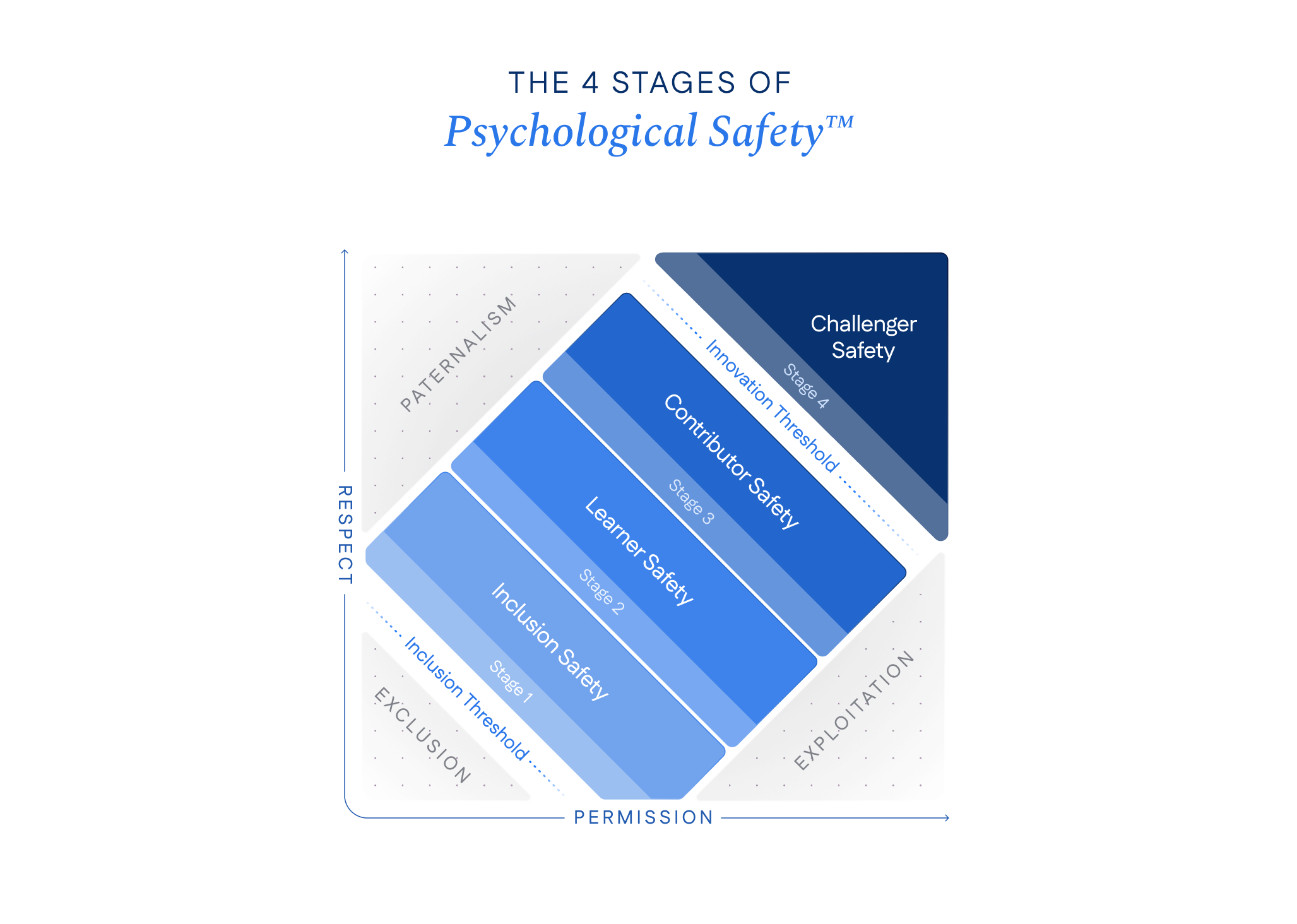
The most useful way to recognize psychological safety examples is by stage. LeaderFactor’s model — built on Dr. Timothy R. Clark’s research and validated in a PSindex® study of 3,366 employees across more than twenty organizations — shows that people satisfy four needs in a predictable sequence. In that study, 65% of respondents named inclusion as the very first thing they seek on a new team, 63% named learning second, 81% named contribution third, and 86% named challenging the status quo last (a Friedman test confirmed the ordering at p < .001, with strong agreement across participants). In other words, the stages aren’t a menu — they’re a staircase, and examples of safety look different on each step.
Stage 1 — Inclusion Safety examples
Inclusion Safety means you feel accepted and able to belong simply for being human and harmless — here, worth precedes worthiness. You can spot it in these examples:
- A manager learns a new hire’s name and how to pronounce it on day one, and introduces them around personally.
- People in a meeting physically face whoever is speaking, listen, and pause before responding instead of waiting to pounce.
- A leader asks a quiet team member, “What’s your take?” — deliberately drawing in someone outside the usual inner circle.
- A senior executive doesn’t flaunt perks or hide behind title; they eat lunch with the team and follow through on small commitments.
What it looks like when it’s missing: superiority and hierarchy dominate, cliques form, people are talked over, and someone can be officially “on the team” without ever feeling part of it.
Stage 2 — Learner Safety examples
Learner Safety means you can engage in the vulnerable acts of learning — asking questions, admitting you don’t know, trying something new, making mistakes — without being embarrassed or marginalized. Examples include:
- A team runs a “lessons learned” debrief after a failed project and genuinely celebrates the failure as evidence of trying, not a mark against anyone.
- A leader openly shares a past mistake and what they learned from it, which signals everyone else can too.
- A manager says “I don’t know” without flinching, and asks for help from someone junior — modeling humility in learning.
- Someone asks a basic clarifying question in a large meeting and gets a genuine answer, not a smirk.
What it looks like when it’s missing: mistakes get hidden and punished, questions feel risky, and the team executes far more than it innovates.
Stage 3 — Contributor Safety examples
Contributor Safety means you’re given real autonomy, role clarity, and support to make a meaningful contribution — with accountability for results. You can see it here:
- A leader delegates with clear expectations and then gets out of the way, letting people do the work their own way instead of micromanaging.
- The team celebrates small wins openly, building momentum rather than waiting for a single big finish.
- A manager rotates who runs the meeting, handing real ownership to different people.
- When performance dips, a leader approaches it with curiosity (“What’s getting in the way?”) rather than anger, blame, or shame.
What it looks like when it’s missing: autonomy is handed out with no guidance, “shutdown statements” like bad idea or nice try end discussions, and capable people quietly disengage into benchwarmers.
Stage 4 — Challenger Safety examples
Challenger Safety is the hardest and highest stage: people feel safe to challenge the status quo — to disagree, dissent, and push for change — because leaders give “air cover” in exchange for candor. This is where innovation lives. Examples:
- A junior team member tells a senior leader their plan has a flaw, and the leader thanks them and revisits the decision.
- The leader weighs in last in a debate so their positional power doesn’t silence the room.
- A team holds a blameless post-mortem where dissent is expected, and the boss asks for the bad news.
- When a leader rejects someone’s suggestion, they explain why — so the person keeps speaking up next time.
What it looks like when it’s missing: teams fall silent, people are punished for their bravery and candor, and groupthink hardens into an echo chamber.
Examples of behaviors that build psychological safety
The stages describe what safe teams feel; behaviors describe how leaders create it. LeaderFactor’s Behavioral Guide breaks the model into more than 100 specific, do-it-this-week behaviors. The mechanism underneath every one of them is simple and has no shortcut: model vulnerability yourself, then reward the vulnerability of others. A few high-leverage examples:
- Ask twice as much as you tell. Questions are invitations to engage; over-telling signals dominance and shuts people down.
- Identify and remove negative bias. Periodically ask the team where bias is creeping in, then act on it.
- Make yourself available and interruptible. It sends the message that you value people over tasks.
- Reward “shots on goal.” Recognize attempts to challenge the status quo even when the idea doesn’t land, so people keep taking them.
- Report your own mistakes and errors. Leaders who admit fault earn trust and stop their teams from hiding problems.
What a lack of psychological safety looks like
A lack of psychological safety is the result of punished vulnerability, and it’s worth studying because it’s often invisible. Some punishment is macroscopic and clearly against policy — bullying, public shaming, retaliation. But most is microscopic and almost undetectable, which is how “nice” cultures quietly suffocate candor by painting a thin layer of nice over a thick layer of fear. Common acts of punished vulnerability include:
- Dismissing requests for help or reacting poorly to mistakes and failures.
- Ignoring effort while expecting perfection, and taking feedback badly.
- Assigning something new with no clear expectations, then criticizing the result.
- Shutting down candor or challenges to the status quo.
Two failure patterns are especially common. Paternalism pairs high respect with low permission — the well-meaning “helicopter” boss who pats people on the head and says I love you, don’t touch anything, holding capable people back. Exploitation pairs low respect with high permission — valuing what people produce but not the people themselves, running from subtle credit-stealing all the way to harassment. Both starve a team of safety from opposite directions.
How to measure psychological safety (with an example)
Most organizations try to measure psychological safety with a single question buried in a broad engagement survey — and that isn’t enough. Because safety is staged, an average score hides the real story. A team can post high overall numbers while sitting on a dangerous imbalance: strong inclusion and Learner Safety, but weak Challenger Safety — meaning people feel they belong and can learn, but won’t tell leadership the emperor has no clothes.
A dedicated tool surfaces that. LeaderFactor’s PSindex® combines quantitative and qualitative data to score a team across all four stages in about five minutes per participant, plus confidential written feedback, so leaders can pinpoint exactly which stage is breaking down and act on it. That’s the difference between knowing that something’s off and knowing where.
Where to go next
Psychological safety isn’t a personality trait or a perk; it’s a set of conditions leaders create on purpose, one stage and one behavior at a time. Every example above — the thanked mistake, the drawn-in newcomer, the heard objection — is the same move repeated: vulnerability, rewarded. Start by naming which stage your team is stuck at, then borrow the behaviors from that stage.
To go deeper, explore the 4 Stages of Psychological Safety model, review the psychological safety and PSindex® definitions in the glossary, and see how the model plays out beyond the office in emotional safety at work.
Frequently asked questions
- What are some examples of psychological safety at work?
- Examples include a teammate admitting a mistake and being thanked instead of blamed, a new hire asking a basic question without embarrassment, someone volunteering a half-formed idea, and a junior employee challenging a senior leader's plan and being heard. Each is an act of vulnerability that gets rewarded rather than punished.
- What does psychological safety look like at each of the four stages?
- Examples differ by stage, because psychological safety builds in sequence. Inclusion Safety satisfies the need to belong, Learner Safety the need to grow, Contributor Safety the need to make a difference, and Challenger Safety the need to make things better. The stages aren't a menu — they're a staircase.
- What does a lack of psychological safety look like?
- A lack of psychological safety shows up as punished vulnerability: people stay silent in meetings, hide mistakes, stop asking for help, and never challenge decisions. Signs include leaders reacting to bad news with anger, teammates being talked over, effort ignored while perfection is expected, and a 'nice' surface hiding real fear.
- What is a real example of psychological safety on a team?
- A team runs a blameless post-mortem after a failed launch: instead of assigning blame, the leader shares their own missteps first, and members openly analyze what broke. People feel safe enough to be candid, so the team surfaces the real causes and fixes them — turning a failure into rewarded vulnerability.
- How do you measure psychological safety with examples?
- Measure it with a survey built specifically for psychological safety rather than one engagement question. LeaderFactor's PSindex scores a team across all four stages, so leaders see exactly where safety breaks down — for example, high inclusion but low Challenger Safety, meaning people feel they belong but won't speak up about problems.