





Culture consulting
Culture consulting that changes behavior, not slideware: measure culture with PSindex®, then shift the 4 Stages that drive engagement, retention, and innovation.
Culture consulting is professional help to assess and change your organization’s culture — the way people actually interact — so it drives performance instead of quietly draining it. The best culture consulting doesn’t hand you a values statement and an inspiring offsite; it measures the culture you have today, defines the specific behaviors that need to change, and coaches leaders to change them until new norms hold. That distinction matters, because most culture work fails for one reason: it broadcasts new values without changing what actually gets rewarded and punished in daily work.
At LeaderFactor, the wedge is simple. Culture is not a mood or a mystery — it is observable, behavioral, and measurable. We define the culture you’re trying to build as a culture of rewarded vulnerability, quantify it with the PSindex®, and change it through the 4 Stages of Psychological Safety™. That gives leaders something big generic consultancies rarely deliver: a baseline number, a mechanism, and a re-measurement that proves the behavior actually shifted. This page explains what culture consulting is, what to look for in a partner, and why a behavior-based, measurable approach outperforms slideware.
What is culture consulting?
Culture consulting is an engagement in which an outside partner helps an organization diagnose its culture, decide what needs to change, and change it. In practice that spans cultural assessments, leadership development, and change management — the three services almost every firm names. The problem is that “change management” and “leadership development” mean wildly different things from one provider to the next, and the label tells you nothing about whether behavior will actually move.
The most useful working definition of the thing you’re trying to change is the simplest: culture is the way we interact. Attitudes, beliefs, traditions, and values all matter, but they only become culture when they show up at the human interface — the moment two or more people actually work together. That reframe is what makes culture consulting tractable. If culture is behavior at scale, then it can be observed, measured, and rebuilt deliberately — rather than “shifted” through posters, town halls, and hope.
That’s why LeaderFactor draws a hard line between two kinds of culture consulting:
- Awareness-based — assess, present findings, run a workshop, deliver a strategy deck, and leave execution to the client. It informs people. It rarely changes what they do.
- Behavior-based — measure the culture with an instrument, target the specific behaviors that drive the gap, coach leaders to model and reward those behaviors, then re-measure. It changes what people do, and it can prove it.
Why do companies hire a culture consultant?
Companies hire a culture consultant because culture is the operating system underneath every other result — and when it’s broken, strategy dies in the way people behave. Leaders usually reach out when they can feel the symptoms but can’t fix them from inside: good people leaving, ideas that never surface until it’s too late, the real conversation happening in the hallway after the meeting, initiatives stalling because no one will say they won’t work.
Those symptoms trace back to one variable. Psychological safety — whether people feel safe to speak up, ask questions, contribute, and challenge — is positively correlated with 10 critical organizational outcomes: customer experience, inclusion, mental health and wellness, engagement, physical safety, resilience, learning agility, retention, productivity, and innovation. When a culture punishes vulnerability, people shift into a fear response and freeze their discretionary effort; when it rewards vulnerability, they release it. A culture consultant worth hiring is really being hired to move that variable — and, through it, the outcomes leadership actually cares about.
An outside partner helps for a specific reason: leaders are the primary cause of their team’s culture, which makes it genuinely hard to see from the inside — the people setting the norms are the least able to perceive them. A good consultant brings an instrument that surfaces the gap between how leaders think they show up and how their teams actually experience them, plus the objectivity to make that gap safe to discuss.
What services does culture consulting include?
Strong culture consulting engagements share a common spine — assess, define, build, and sustain — even when providers package it differently. Use these four as your checklist when comparing partners; a provider that’s thin on any one of them is likely to inform your people without changing them.
Cultural assessment and diagnosis
Every credible engagement starts by measuring the culture you have — honestly, including the unwritten norms, not the aspirational ones. The differentiator is what gets measured and how rigorously. LeaderFactor uses the PSindex®, a psychometrically validated, multi-rater instrument built to the AERA Joint Standards for educational and psychological testing. It scores psychological safety across the four stages from multiple perspectives — self, manager, peers, and direct reports — at the intact team level, the smallest divisible unit of culture. That surfaces exactly where a team feels unsafe and quantifies it on a −100 to +100 scale, so “our culture needs work” becomes a specific, trackable number.
Leadership development and coaching
Because leaders set what gets rewarded and punished, culture consulting has to change leaders’ behavior, not just their awareness. This is where awareness-based approaches fall down: they explain the concept and stop. Behavior-based work equips leaders to model vulnerability themselves and reward it in others — the one mechanism that actually raises psychological safety — and holds them accountable to specific, observable behaviors over weeks, not a single session.
Change management and behavior change
Culture change lives in daily behavior, so this is the heart of the work, not an afterthought. The goal is to change what gets rewarded and punished at the human interface until new norms replace old ones. That means concrete action plans — one specific behavior per stage, practiced deliberately with weekly reflection over four to six weeks — rather than a communications plan and a launch event.
Measurement of results
The service that separates real culture consulting from theater is re-measurement. LeaderFactor re-administers the PSindex® roughly 90 days after the work to show movement across the four stages, then ties it to the business outcomes it drives. If a provider can’t tell you how they’ll prove the change, they’re selling you a workshop, not a result.
How does LeaderFactor approach culture consulting?
LeaderFactor’s approach is behavior-based and measurable end to end: define culture as rewarded vulnerability, measure it with the PSindex®, and change it through the 4 Stages of Psychological Safety™. Where big consultancies are strong on diagnosis and strategy but leave execution to you, this approach is built around the one thing that actually moves culture — what leaders model and reward every day.
The starting premise is that everyone is a cultural architect. Regardless of title, every person radiates influence and shapes the prevailing norms through the behaviors they model and reinforce — and there’s no off switch. That reframes the whole engagement: culture isn’t something HR “rolls out,” it’s something every leader is building or eroding in every interaction. The consultant’s job is to make that influence intentional.
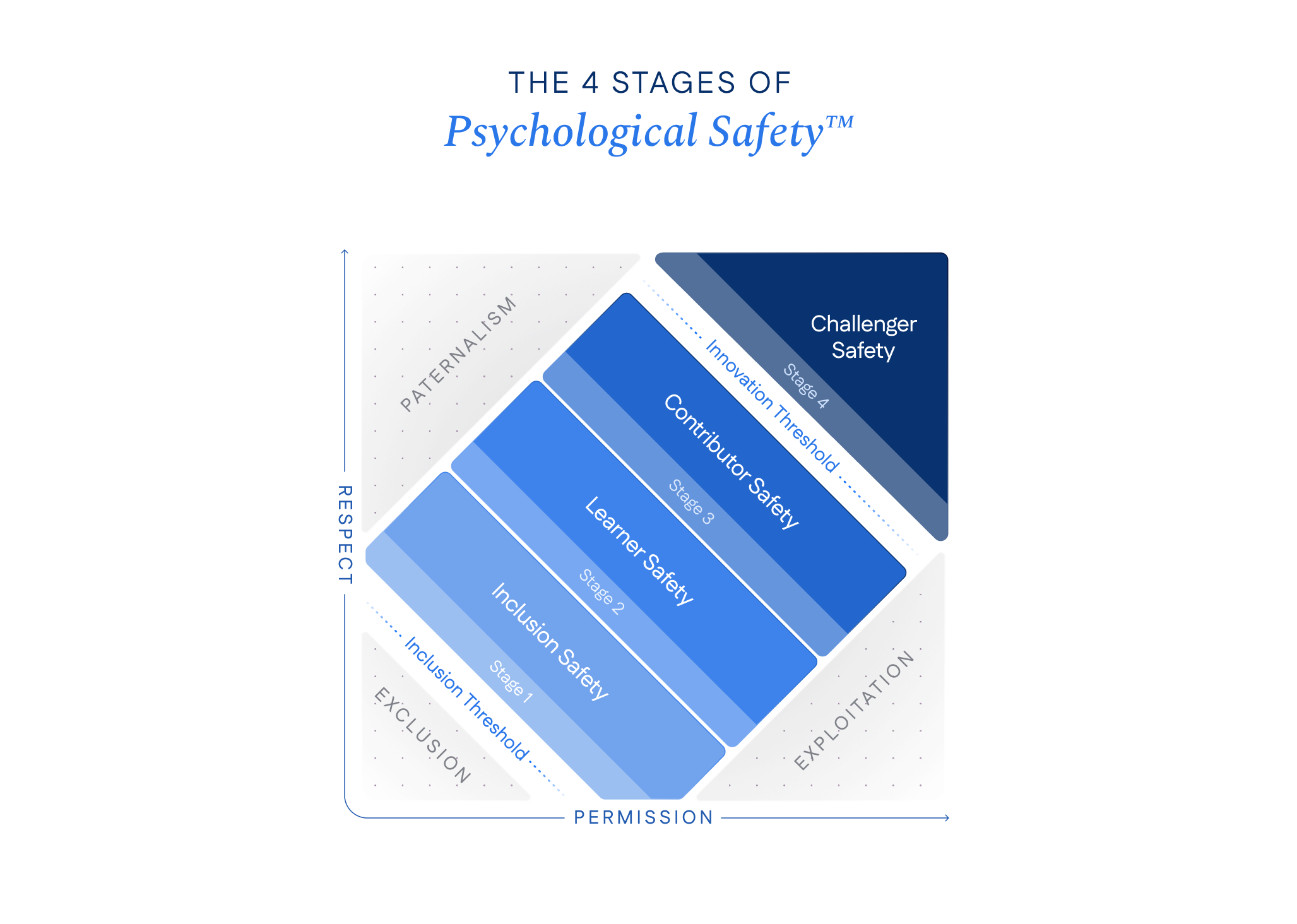
The 4 Stages of Psychological Safety
The framework gives the work a sequence — you can’t skip stages. Each stage satisfies a universal human need and unlocks the next:
- Stage 1 — Inclusion Safety. People feel accepted for who they are and safe to belong. The exchange is inclusion for humanity; without it, nothing else holds.
- Stage 2 — Learner Safety. People feel safe to ask questions, give and receive feedback, and make mistakes. The exchange is encouragement for engagement.
- Stage 3 — Contributor Safety. People feel safe to use their skills and contribute with appropriate autonomy. The exchange is autonomy with guidance for results.
- Stage 4 — Challenger Safety. People feel safe to challenge the status quo and dissent in good faith without fear of retaliation. The exchange is air cover for candor — and it’s where innovation lives, because teams can hold high intellectual friction while lowering social friction.
Diagnosing which stage a team is stuck at is what turns “improve our culture” into a targeted plan. A team can be strong on inclusion but weak on challenger safety — a common pattern that quietly kills innovation — and the PSindex® stage scores show it precisely.
How do you measure the results of culture consulting?
You measure results by re-assessing the same baseline you started from — and if a provider can’t tell you how they’ll do that, treat it as a red flag. LeaderFactor scores psychological safety with the PSindex® before the engagement and again roughly 90 days later, so leaders can see movement across all four stages rather than relying on how the workshop felt. Because the instrument is validated and multi-rater, the score isn’t a vanity metric; it reflects how peers and direct reports actually experience the team, not just how the leader rates themselves.
From there, the culture score connects to the outcomes leadership already tracks. Because psychological safety is correlated with engagement, retention, learning agility, innovation, and the rest of the 10 outcomes, a rising PSindex® is a leading indicator for the business results that justify the investment. That’s the accountability loop most culture consulting skips: a number going in, a number coming out, and a mechanism connecting the two.
What to look for when choosing a culture consulting partner
Choose a culture consulting partner the way you’d choose any high-stakes vendor: by what they can prove, not what they promise. The market is crowded with big generic consultancies and boutique firms that all name the same three services — assessment, leadership development, change management. The questions below separate behavior-based partners from slideware:
- Do they measure culture with a validated instrument — before and after? If the “assessment” is an informal survey with no baseline you can re-run, you can’t prove change.
- Do they work at the behavioral level? Ask what specific behaviors leaders will practice. “Alignment,” “engagement,” and “moments of truth” are outcomes, not behaviors. Real change names the acts.
- Do they change leaders, or just inform employees? Culture flows from what leaders reward and punish. Work that skips leader accountability rarely holds.
- Is there a mechanism, or just best practices? A defensible approach can explain why the intervention changes behavior. LeaderFactor’s is explicit: model vulnerability, reward it in others.
- Do they hand you execution, or run it with you? Diagnosis-and-strategy leaves the hardest part — sustaining new behavior — to you. Look for a partner that stays through practice and re-measurement.
For deeper reading on the mechanism behind durable change, see our guide to how to change organizational culture; for what’s at stake when it goes wrong, see low psychological safety.
Where to go next
If you’re evaluating culture consulting, the fastest way to make it concrete is to see the framework and measure your own team. Explore the 4 Stages of Psychological Safety™ to understand the model your leaders would practice, review creating a psychologically safe environment for the behaviors it installs, and read the benefits of psychological safety for the outcomes it drives. Culture consulting is only worth what it changes — so start with a measure, insist on a mechanism, and hold the work to a re-measurement that proves it stuck.
Frequently asked questions
- What is culture consulting?
- Culture consulting is professional help to assess and change an organization's culture — the way people actually interact — so it drives performance instead of holding it back. Effective culture consulting measures the current culture with a validated instrument, defines the specific behaviors to change, and coaches leaders to model and reward those behaviors until new norms hold.
- How much does culture consulting cost?
- Culture consulting is priced by scope: a single leadership workshop and baseline assessment costs far less than an enterprise transformation across dozens of teams. The more useful question is what you're buying. Work that stops at a survey and a slide deck rarely changes behavior; work that measures culture, coaches leaders, and re-measures at 90 days is what moves real metrics.
- What does a culture consultant actually do?
- A culture consultant diagnoses how a team interacts, pinpoints where people don't feel safe to speak up or challenge ideas, and equips leaders to change it. The strongest consultants work at the behavioral level — measuring culture with an instrument like the PSindex®, targeting specific behaviors, and holding leaders accountable — rather than delivering values statements and awareness training.
- How do you measure the results of culture consulting?
- Measure culture consulting by re-assessing the same baseline you started with. LeaderFactor uses the PSindex®, a validated multi-rater survey scoring psychological safety across four stages, before and roughly 90 days after the work. Pair that with business outcomes it drives — engagement, retention, learning agility, and innovation — so you can prove behavior change, not just satisfaction with a workshop.
- How is LeaderFactor's culture consulting different from a big consulting firm?
- Large firms often diagnose culture, deliver a strategy, and leave execution to you. LeaderFactor's culture consulting is behavior-based and measurable: it defines culture as rewarded vulnerability, scores it with the PSindex®, and coaches leaders to model and reward the specific behaviors that build the four stages of psychological safety — then re-measures to prove the change stuck.