





Psychological safety in the workplace
Psychological safety in the workplace is a culture of rewarded vulnerability. Learn the definition, the four stages, the outcomes it drives, and how to build it.
Psychological safety in the workplace is the shared belief that you can take interpersonal risks — speaking up, asking a question, admitting a mistake, or challenging the status quo — without fear of being embarrassed, rejected, or punished. LeaderFactor defines it in five words: a culture of rewarded vulnerability. It is not niceness, comfort, or lowered standards. It is the condition that lets people bring their full effort and ideas to work instead of holding back to protect themselves.
This is the overview page for the topic. Below, you’ll find what psychological safety means, why it matters, the framework that explains how it develops, how to build and measure it, and what gets in the way — with links to deeper articles on each. If you already know the basics and want the model, jump to the four stages of psychological safety.
What is psychological safety in the workplace?
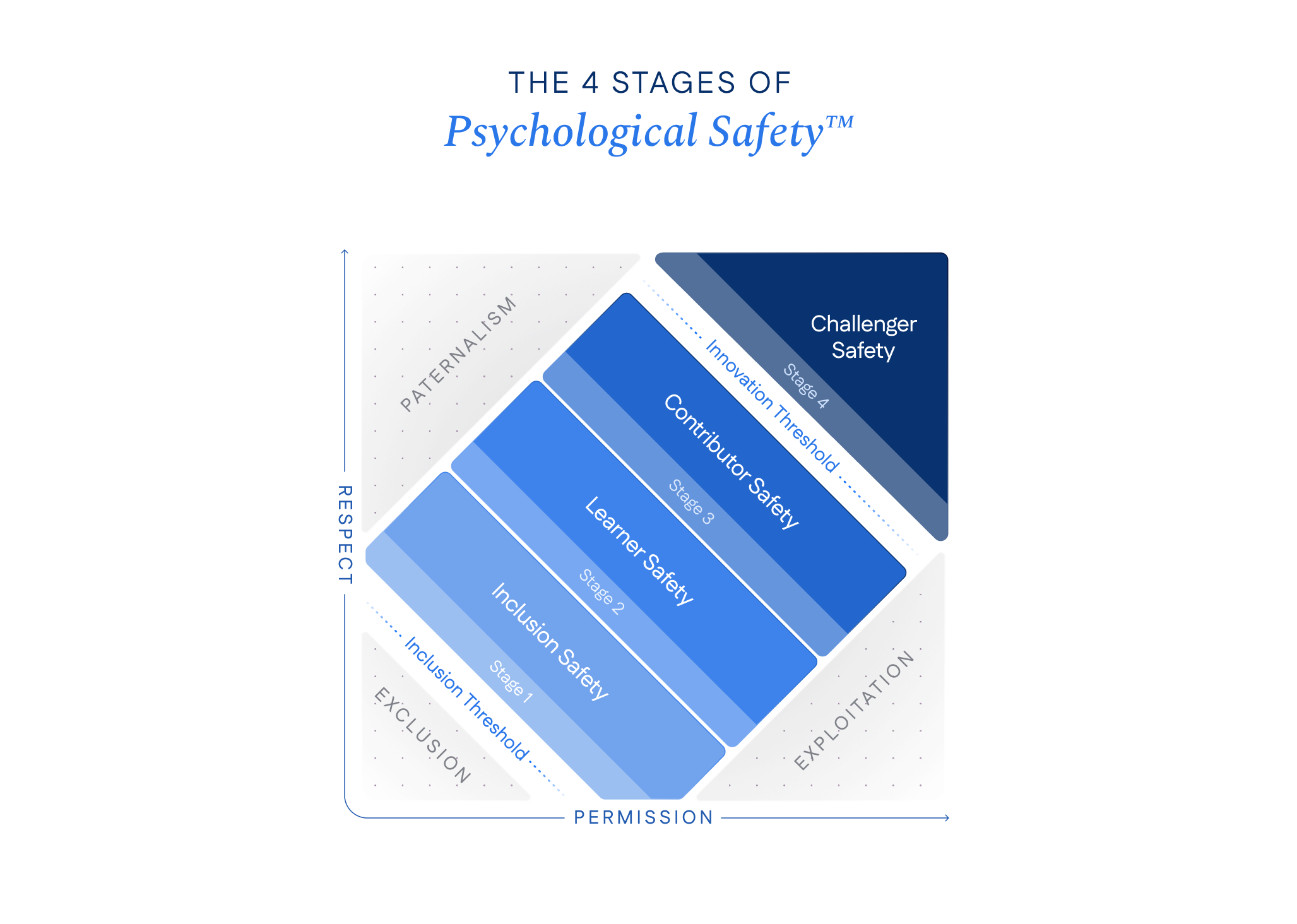
Psychological safety in the workplace is an environment where people feel safe to be vulnerable in front of one another. According to LeaderFactor and Dr. Timothy R. Clark, psychological safety is a function of two things: respect and permission. Where both are high, people are treated as human beings and granted permission to participate, so they feel safe. Where one is missing, safety breaks down into a predictable failure pattern.
It helps to be precise about the mechanism. Whenever humans enter a social setting, they instinctively run threat detection — scanning to answer one question: Am I in a safe environment? The answer governs behavior. Conclude the environment rewards vulnerability, and you give a performance response: you jump in, contribute, and release your discretionary effort. Conclude it punishes vulnerability, and you give a fear response: you withdraw, self-censor, and manage personal risk. That shift from adding value to merely surviving is not a small difference — it is the difference between a team that performs and one that protects itself.
For a fuller treatment of the term itself, see our definition of psychological safety and the psychological safety glossary entry.
Why psychological safety matters at work
Psychological safety matters because it is directly and positively correlated with ten critical organizational outcomes. In LeaderFactor’s research, higher psychological safety tracks with better:
- Customer experience
- Inclusion
- Mental health and wellbeing
- Employee engagement
- Physical safety
- Resilience
- Learning agility
- Retention
- Productivity
- Innovation
The connection is causal in mechanism, not just correlational in data. Consider physical safety: to keep a worksite safe, employees have to be willing to point out hazards, risks, and near-misses. In a low-safety culture they stay quiet; in a high-safety culture they speak up — so psychological safety becomes a leading indicator of the physical kind. The same logic runs through every outcome on the list: each depends on someone being willing to say the vulnerable thing.
That is why Dr. Clark calls the development of psychological safety “the single biggest breakthrough in organizational science in a generation.” For the full outcome-by-outcome breakdown, see the benefits of psychological safety.
The four stages of psychological safety
Psychological safety is not a single switch that flips on. It develops through four sequential stages, each satisfying a different human need and each built on the one before it. This is The 4 Stages of Psychological Safety™, LeaderFactor’s core framework:
- Inclusion Safety — you feel accepted, respected, and that you belong. This is the foundation; it satisfies the need to be included.
- Learner Safety — you feel safe to engage in learning: asking questions, giving and getting feedback, trying new things, and making mistakes without being marginalized.
- Contributor Safety — you feel safe to make a meaningful contribution, which requires an appropriate level of autonomy, role clarity, and support.
- Challenger Safety — you feel safe to challenge the status quo and propose change without fear of reprisal. This stage sits past the innovation threshold, because this is where teams innovate.
The goal is to move a team all the way to Challenger Safety and then maintain those conditions — the work of what LeaderFactor calls a cultural architect.
Two failure patterns to avoid
Because psychological safety lives at the intersection of respect and permission, it breaks in two characteristic ways when one of those is missing:
- Paternalism — high respect, low permission. The leader means well but acts like a helicopter parent: “I love you, don’t touch anything.” This is the pattern of the micromanager, who gets in the way and holds people back. It suppresses contributor and Challenger Safety.
- Exploitation — low respect, high permission. The leader grants latitude but doesn’t value people as human beings; the aim is to extract value. It ranges from subtle (stealing credit, overloading a strong performer) to overt (bullying, public shaming).
Naming which pattern you drift toward is often the fastest route to improvement. For more on what erodes safety, see barriers to psychological safety.
How to build psychological safety
You build psychological safety through one central mechanism, and there is no shortcut around it:
- Model vulnerability yourself. Acknowledge mistakes, ask for help, admit what you don’t know, and invite challenge — in front of the team.
- Reward the vulnerability of others. When someone asks a question, floats a half-formed idea, or disagrees with you, respond with appreciation and curiosity rather than punishment.
That’s it. Model vulnerability, reward the vulnerability of others — repeated consistently until it becomes the norm. Because norms form almost immediately when people start interacting, leaders set the tone fast, for better or worse. Practical moves that operationalize the mechanism include setting clear expectations for respectful candor, practicing active listening without judgment, treating feedback as an opportunity rather than an attack, and being transparent about decisions. For the full playbook, see building psychological safety in teams.
How to measure psychological safety
You measure psychological safety with a dedicated, validated instrument rather than a generic engagement survey — because engagement measures how people feel about work, while psychological safety measures whether they feel safe to be vulnerable at work. LeaderFactor’s PSindex® is a multi-rater, psychometrically validated survey (built to the AERA Joint Standards) that scores a team across all four stages using twelve behavioral items, such as “I can take reasonable risks without being punished.”
PSindex® maps every response into one of three zones — a Blue Zone (consistently rewarded vulnerability), a Neutral Zone (inconsistent, unpredictable), or a Red Zone (consistently punished vulnerability) — and scores the team by subtracting the Red Zone percentage from the Blue Zone percentage on a −100 to +100 scale. Because it’s measured at the intact-team level and compares self-ratings against peers’ and direct reports’ perceptions, it shows leaders exactly which stage a team is stuck on and where perception gaps hide. See how to measure psychological safety for the full method, and the PSindex® glossary entry for the definition.
What psychological safety is not
A large part of building psychological safety is protecting the concept from misuse. LeaderFactor is explicit that psychological safety is not:
- A shield from accountability — it is not diplomatic immunity from standards.
- Coddling — it does not mean wrapping people in bubble wrap.
- Consensus decision-making — it does not change who makes the call.
- Niceness — teams that reduce it to niceness paint a thin layer of nice over a thick layer of fear.
- Political correctness — it is apolitical and subscribes to no ideology.
- Unearned autonomy — autonomy is still earned through performance.
- Verbal reassurance — you cannot declare a culture safe into existence; leaders are responsible for conditions, not announcements.
The through-line: psychological safety pairs high candor with high accountability. It raises the bar on honesty; it does not lower the bar on results. For the fuller list, see what psychological safety is not.
Where to go next
This page is the overview. To go deeper on any part of the topic:
- The framework — The 4 Stages of Psychological Safety
- How to build it — Building psychological safety in teams
- How to measure it — How to measure psychological safety
- Why it pays off — The benefits of psychological safety
- What gets in the way — Barriers to psychological safety
Psychological safety in the workplace isn’t a mood or a perk — it’s a measurable culture of rewarded vulnerability that determines whether your people give you their best thinking or hold it back. Name the stages, model and reward vulnerability, and measure your progress, and you build the foundation every other outcome sits on.
Frequently asked questions
- What is psychological safety in the workplace?
- Psychological safety in the workplace is a culture of rewarded vulnerability — an environment where speaking up, asking questions, admitting mistakes, and challenging the status quo are met with reward rather than punishment. LeaderFactor frames it as the intersection of respect and permission, not niceness or comfort, so people can take interpersonal risks without fear.
- Why does psychological safety matter at work?
- Psychological safety is positively correlated with ten organizational outcomes, including engagement, retention, learning agility, productivity, inclusion, resilience, wellbeing, physical safety, customer experience, and innovation. In safe environments people give a performance response and release discretionary effort; in unsafe ones they give a fear response and self-censor to protect themselves.
- How do you create psychological safety in the workplace?
- You create psychological safety through one mechanism: model vulnerability yourself, then reward the vulnerability of others. Leaders acknowledge their own mistakes, ask for input, and respond to candor with appreciation rather than punishment. Because norms form fast, this modeling and rewarding must be consistent across every one of the four stages.